Black History Month Day 2: The Lie of “A Few Bad People”
Hello readers!
Some truths take a long time to land, not because they are complicated, but because they are inconvenient.
Black History Month invites us to sit with those truths without rushing to soften them. It asks us to remember that history is not a story we tell about the past. It is a set of patterns that continue to shape the present.
Here is one of those truths.
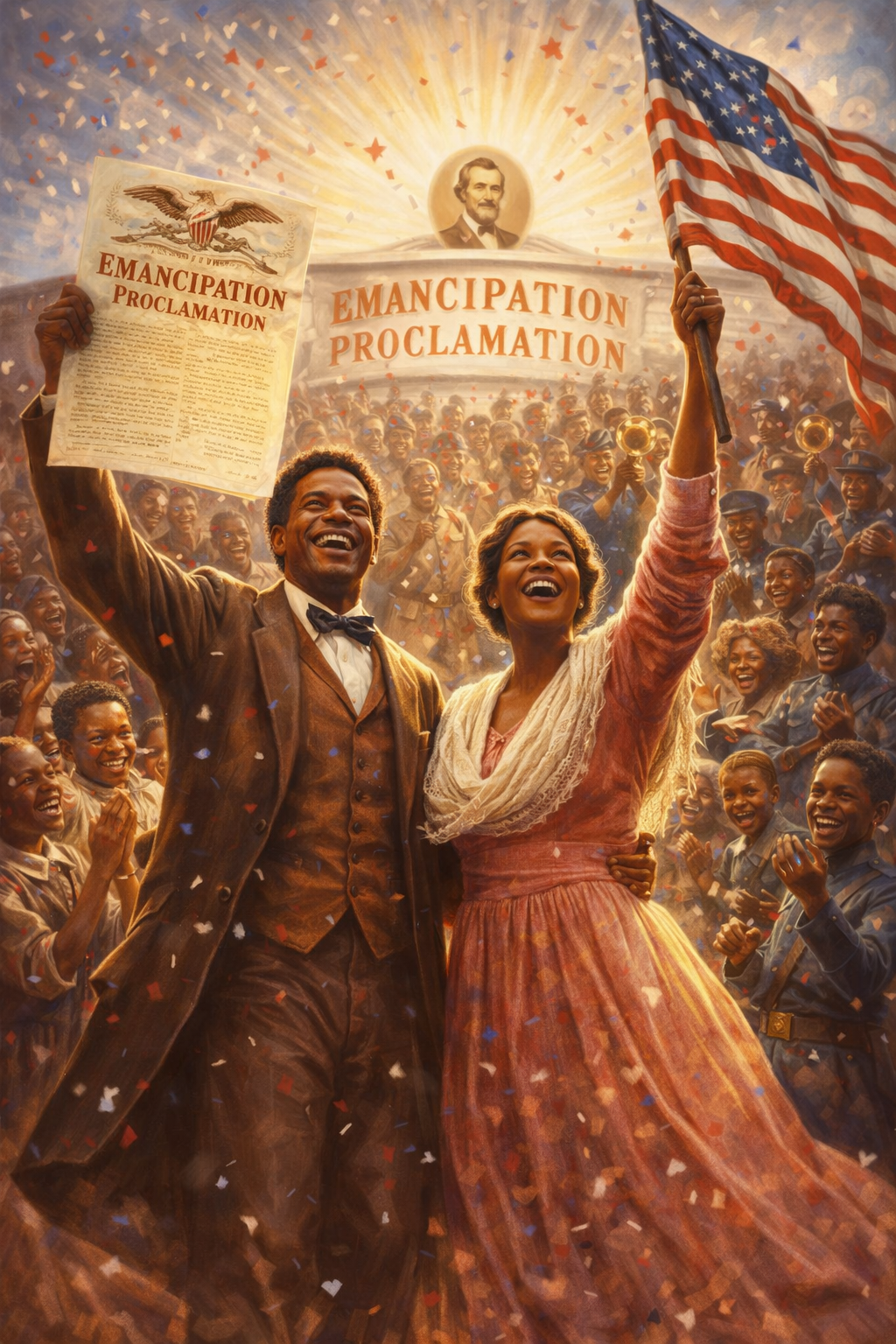
Black History Fact: The Emancipation Proclamation did not free all enslaved people. Many remained enslaved for years afterward, especially in states where enforcement was weak or nonexistent.
Freedom, in America, has always come with conditions.
Black history teaches us that declarations are not the same as reality. Laws written on paper do not automatically translate into justice lived in bodies. Rights delayed are rights denied, and delay has been one of this nation’s most reliable tactics.
Even after slavery was formally abolished, freedom was rationed. Access to land was denied. Promises were broken. Violence enforced “order.” The message was clear and consistent: freedom would be granted only so far, and no further.
That pattern did not end in the nineteenth century.
We see it repeated through literacy tests, poll taxes, redlining, exclusion from GI Bill benefits, and discriminatory lending practices. Each one legal at the time. Each one defended as reasonable, necessary, or temporary.
Today, we still see rights delayed through bureaucracy, court challenges, voter suppression, and economic barriers. Justice postponed until it becomes abstract. Relief offered just late enough to be meaningless.
Black history reminds us that progress without enforcement is performance.
And performance is cheap.
When we talk about freedom, we should be precise. Freedom to do what. Freedom for whom. And freedom backed by what power.
Because freedom without protection is fragile.
And fragile freedoms are easily revoked.
One of the most comforting lies in American history is the idea that injustice was caused by a few bad people.
A few bad slave owners.
A few bad cops.
A few bad politicians.
A few bad apples.
This lie is seductive because it allows the system itself to remain innocent.
But Black history teaches us something else entirely. Oppression does not survive for centuries by accident. It survives because it is built into laws, policies, and institutions, and because enough people benefit from it to defend it.
Slavery was legal.
Segregation was legal.
Redlining was legal.
Mass incarceration was legal.
None of these required everyone to be cruel. They required enough people to comply, look away, or tell themselves comforting stories.
This is why Black history cannot be reduced to heroes and villains alone. It must include the bystanders. The enablers. The “good people” who did nothing and called it neutrality.
We still cling to the myth that injustice is a glitch rather than a feature. That if we remove the worst actors, the system will heal itself.
History tells us otherwise.
Systems do exactly what they are designed to do.
If Black communities experience worse health outcomes, higher incarceration rates, lower generational wealth, and increased surveillance, the question is not what is wrong with them.
The question is what the system is rewarding.
Black history reminds us that neutrality is not neutral. Silence is not passive. Comfort is not harmless.
And the present day is offering us the same choice it always has.
Disrupt, or comply.
History is watching.
Support Black journalism not as charity, but as citizenship. Read their work. Follow their reporting. Share their words. Democracy depends on whose stories are told—and who is believed when they tell them.
Suggested journalists to support:
Nikole Hannah-Jones
Investigative journalist and Pulitzer Prize winner whose work reshaped how many Americans understand the legacy of slavery.
Wesley Lowery
Former Washington Post reporter known for rigorous reporting on policing, race, and democracy.
Jelani Cobb
Dean of Columbia Journalism School and longtime writer offering deep historical context to present-day politics.
Tremaine Lee
Pulitzer Prize–winning journalist whose work focuses on structural inequality, poverty, and criminal justice.
Yamiche Alcindor
Political reporter and moderator known for clear, persistent questioning and accountability journalism.
Ta-Nehisi Coates
Essayist and reporter whose writing connects history, policy, and lived experience with moral clarity.
Errin Haines
Editor-at-large at The 19th, focusing on democracy, race, gender, and political power.
Elie Mystal
Legal journalist translating complex law and constitutional issues into accessible, often bracing truth.
Clint Smith
Writer and journalist whose work bridges history, poetry, and reporting, especially around memory and injustice.
Imani Perry
Scholar and journalist offering nuanced analysis of race, culture, and American identity.
And of course independent street beat reporter, Don Lemon.
Mindful activism asks us to stay awake without becoming hardened, to tell the truth without losing our humanity, and to remember that how we show up matters just as much as what we oppose. Thank you for being here and for walking this path with me.
Julie Bolejack, MBA
Thank you to my subscribers for reading, reflecting, and sharing this work. If this piece resonated with you, please consider sharing it with others. The best way to avoid algorithms, censors, and overlords is through direct connection.
If you’re not already subscribed, you can join us at julies-journal.ghost.io.