The Bond Market Is Trying to Tell Us Something

Most of us experience the economy in very ordinary places.
At the grocery store.
At the gas pump.
When the electric bill arrives.
When the car needs repaired.
When the property tax bill shows up and we stare at it for a moment wondering whether perhaps they accidentally included the neighbor’s house.
That is understandable.
Those are the prices we see.
But there is another part of the economy most Americans rarely think about.
The bond market.
And right now, I think we need to pay attention to it.
Because while Americans are understandably talking about gasoline and groceries, something considerably larger is happening underneath the surface.
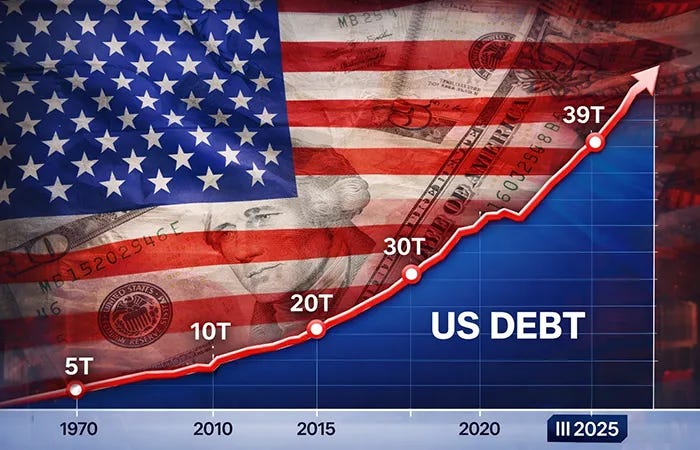
The United States is approaching $40 trillion in national debt.
As I write this, Treasury data put the federal debt at approximately $39.9 trillion. Six years ago, in 2020, it was roughly $27 trillion.
Think about that.
Approximately $13 trillion in additional federal debt in six years.
Some of that enormous increase occurred during the COVID emergency. Some accumulated during the Biden administration. Some is accumulating now.
This is not a problem that began with Donald Trump.
Republicans and Democrats alike have contributed to America’s fiscal problems for decades.
But that doesn’t mean every administration gets an automatic pass for making the problem worse.
And this administration is making choices that deserve very serious scrutiny.
First, We Need to Talk About Bonds
A United States Treasury bond is essentially an IOU.
The federal government borrows money from investors and promises to pay them interest.
For generations, U.S. Treasury securities have been considered among the safest investments in the world.
That matters enormously.
America doesn’t simply borrow a little money now and then.
We borrow constantly.
We borrow to refinance old debt.
We borrow to cover current deficits.
And the price we must pay investors to lend us that money matters enormously.
Right now, investors are demanding considerably higher interest rates for holding long-term U.S. government debt.
In August, the yield on the 30-year Treasury climbed above 5.3 percent — its highest level since 2007.
The 10-year Treasury has been trading around the upper 4-percent range.
This is where I want to be careful.
You may have heard comparisons with the 2008 financial crisis or COVID.
There have certainly been periods of extraordinary bond-market instability during those crises.
But today’s situation is different.
We are not currently experiencing the same type of Treasury-market breakdown that occurred during COVID.
What we are seeing is something troubling in another way:
Investors increasingly want to be paid more to lend America money for a long time.
Why?
Inflation risk.
Enormous government borrowing.
Persistent deficits.
Geopolitical uncertainty.
And questions about whether Washington has any serious plan for dealing with the debt.
That should concern every one of us.
Because Interest Is Becoming Its Own Problem
Here’s the part that rarely makes the evening news.
The government isn’t just borrowing more money.
It has to pay interest on everything it borrows.
The Congressional Budget Office projects federal net interest expense of approximately $1 trillion in 2026.
One trillion dollars.
Not to build bridges.
Not to educate children.
Not to provide health care.
Not to secure the border.
Not to fund cancer research.
Not to fix roads.
Interest.
And CBO projects those annual interest costs could rise to approximately $2.1 trillion by 2036. (Congressional Budget Office)
This is where debt begins feeding on itself.
Higher debt means more borrowing.
More borrowing combined with higher interest rates means larger interest payments.
Larger interest payments contribute to larger deficits.
Larger deficits require more borrowing.
And around we go.
That is why the bond market matters.
And Now The Economy Is Slowing
Meanwhile, the underlying economic data aren’t particularly comforting.
Real GDP grew at an annual rate of just 1.5 percent during the second quarter of 2026, down from 2.1 percent in the first quarter. (Bureau of Economic Analysis)
Then came the July employment report.
The United States lost 23,000 payroll jobs during the month.
Even more telling, average monthly job growth during the previous twelve months was only about 34,000 jobs. (Bureau of Labor Statistics)
That does not mean America is in a recession.
It does mean we shouldn’t be pretending this is a booming economy.
Meanwhile, inflation hasn’t disappeared.
Consumer prices were 3.4 percent higher in July than one year earlier.
Food prices were up 3 percent.
Energy prices?
Up 14.7 percent. (Bureau of Labor Statistics)
So American families are being squeezed from several directions at once.
Slower economic growth.
Weak job creation.
Higher prices.
Higher borrowing costs.
And rapidly accumulating federal debt.
Then There Are The Policy Choices
This is where Donald Trump’s economic policies become part of the conversation.
Last year’s major tax-and-spending legislation is projected by the nonpartisan Congressional Budget Office to increase cumulative federal deficits by approximately $3.4 trillion between 2025 and 2034 compared with its previous baseline. (Congressional Budget Office)
That is occurring while the federal government is already running deficits that CBO describes as large by historical standards.
CBO expects this year’s deficit alone to be roughly $1.9 trillion, or about 5.8 percent of GDP.
For comparison, deficits have averaged about 3.8 percent of GDP over the past fifty years. (Congressional Budget Office)
Tariffs complicate this picture further.
They can raise government revenue, and that part shouldn’t be ignored.
But they can also raise costs, disrupt supply chains, discourage investment and create uncertainty for businesses trying to decide where to build, hire and invest.
Add geopolitical instability, military spending, enormous federal borrowing and persistent inflation risk, and investors have a lot to think about.
Apparently they are thinking about it.
Because they’re asking America to pay them more.
Something Happened This Week That Caught My Attention
On August 19, the United States Treasury announced that beginning in September it will at least double the size of certain buyback operations involving longer-term Treasury securities. (U.S. Department of the Treasury)
A Treasury buyback is not the government magically eliminating the national debt.
It is a debt-management tool intended, among other things, to support liquidity and improve the functioning of the Treasury market.
Treasury buybacks themselves are not unprecedented and shouldn’t be portrayed as evidence of an imminent financial collapse.
But context matters.
The announcement came as long-term borrowing costs had surged to levels we haven’t seen since before the 2008 financial crisis.
That deserves our attention.
Nearly $40 Trillion
I keep returning to that number.
$40,000,000,000,000.
The human brain wasn’t designed to comprehend numbers that large.
So we tend to shrug.
What’s another trillion?
What’s another two trillion?
Washington talks about these numbers as though they were abstractions on a spreadsheet.
They aren’t.
Debt represents future claims on American taxpayers.
And interest payments compete with virtually everything else we might want our government to do.
The Congressional Budget Office now says plainly that America’s current fiscal trajectory “is not sustainable.” (Congressional Budget Office)
Those aren’t my words.
They aren’t Democratic words.
They aren’t Republican words.
They are the conclusion of the Congressional Budget Office.
And we ought to listen.
I’m Not Predicting Armageddon
I want to be very clear about that.
There are people on television and social media who make a living predicting economic catastrophe every fifteen minutes.
Eventually someone will be right.
I don’t want to play that game.
America remains an extraordinarily wealthy, innovative and resilient country.
Treasury auctions are still finding buyers. Investors have not abandoned U.S. government debt. Consumer spending continues. Businesses continue investing. GDP is still growing.
Those facts matter too.
But dismissing legitimate warning signs because the sky hasn’t fallen yet would be equally foolish.
Economies rarely send us a polite engraved invitation announcing trouble.
They send signals.
Employment weakens.
Growth slows.
Debt compounds.
Interest expenses climb.
Investors demand greater compensation for risk.
Borrowing becomes more expensive.
And somewhere along the way people discover that the problem they thought belonged to Washington has arrived at their front door.
Through mortgage rates.
Credit cards.
Car loans.
Business investment.
Retirement accounts.
Taxes.
And ultimately the government’s ability to afford the things Americans expect it to provide.
Look Beyond the Gas Pump
So yes, pay attention to gasoline.
Pay attention to eggs.
Pay attention to your grocery bill.
Those things matter enormously, particularly to families living paycheck to paycheck.
But don’t mistake the most visible part of the economy for the entire economy.
There is something much larger happening.
Nearly $40 trillion in federal debt.
Approximately $1 trillion a year already going toward net interest.
Historically high long-term borrowing costs by recent standards.
Weak job creation.
Slowing growth.
Persistent inflation.
And federal policies projected to add trillions more to future deficits.
I don’t know exactly where this ends.
Neither does Donald Trump.
Neither does Congress.
Neither does Wall Street.
And anyone claiming otherwise is selling something.
But I know this:
The bond market is talking.
And right now, I think Americans should stop arguing exclusively about the price displayed on the gas-station sign long enough to hear what it is saying.
Because sometimes the greatest economic danger isn’t the number we’re looking at.
It’s the one we haven’t been watching.
— Julie Bolejack, MBA
The Mindful Activist
For more of my writing, books, podcast conversations and thoughts about navigating this complicated chapter of our lives, visit JulieBolejack.com.
And if someone forwarded this newsletter to you, I hope you’ll subscribe. We have a lot to talk about — and I intend to keep looking beyond the headlines.
NOTE: After drafting this, I read that the government officially announced we had reached a federal deficit of 40 trillion. In a shameful game of hide the ball, Treasury Secretary Bessent dismissed concerns about the bond market with a buy back to stabilize the bond market (hint, it won’t work).
Then last night I received this email from Robert Reich, former Treasury Secretary during the Obama administration. I am sharing it and suggest you subscribe to his substack if this topic interests you.

Who’s Raking it in as the National Debt Explodes?What the wealthy and powerful — and Treasury Sec. Scott Bessent — don’t want you to know
Friends, The U.S. national debt has officially surpassed $40 trillion, months earlier than forecasters had expected — because of billions of dollars in lost revenue from Trump’s invalidated tariffs, Trump’s tax cuts (mostly to big corporations and the very wealthy), and the soaring costs of Trump’s war. Trump’s hair-brained treasury secretary, Scott Bessent, says there’s nothing to worry about because the fiscal trajectory will stabilize. Investors obviously don’t believe him because they’re demanding much higher compensation for buying and holding American bonds. The yield on 30-year U.S. Treasuries hit its highest level in nearly two decades this week, reflecting those growing concerns. Should you worry? Well, it’s not as if we’re heading into a depression. Passing the $40 trillion threshold doesn’t suddenly cause the world to lose confidence in the dollar. The problem is that an increasing portion of our nation’s budget — and your tax dollar — is dedicated to paying interest on this growing debt. Annual net interest payments on the federal debt have surpassed $1 trillion, making servicing the debt one of the largest of all federal budget expenditures. That’s money we don’t spend on schools, healthcare, roads and bridges, and social safety nets. We’ll soon be paying more in interest on the federal debt each year than we spend annually on Medicare. So, who exactly receives these interest payments? This is an issue you hear very little discussion about, because the wealthy and powerful of this country would rather you not know. (And don’t expect Trump suck-up Bessent* to tell you, because he’s too busy denying that economic inequality is worsening.) Foreign governments and foreign investors hold only about 30 percent of our debt. The rest — roughly 70 percent — is held domestically. That is, we pay the interest to ourselves. And who, exactly, is the “ourselves” who receive these interest payments? The Federal Reserve holds part of this debt, state and local governments hold part. But the biggest chunk — nearly half — is held by mutual funds, pension funds, insurance companies, and banks. And who owns them? Americans who invest in these funds — and who thereby, directly or indirectly, hold Treasury bills. And who, exactly are these Americans — the Americans who are directly or indirectly collecting a large amount of the interest we’re paying on the national debt? People at the top. The richest 1 percent of U.S. households hold about 35.6 percent of all financial assets — shares of stock, corporate bonds, and Treasury bills — so it’s safe to assume they hold at least a third of all Treasury bills. Here’s where things get really interesting. Decades ago, wealthy Americans financed the federal government mainly by paying taxes. Their tax rate was far higher than it is today. In the 1950s, under President Dwight Eisenhower, the richest Americans paid a marginal tax rate of 91 percent. (Tax deductions and tax credits lowered this top effective marginal rate somewhat.) Today, the tax rate on wealthy Americans is far lower. The richest 400 Americans pay an average effective total tax rate of about 24 percent — including federal, state, local, and corporate taxes. Jeff Bezos — America’s second or third richest person — paid no federal income taxes in 2018. Trump paid no federal taxes for years before he became president. So now, wealthy Americans finance the federal government mainly by lending it money and collecting interest payments on those loans. As I said, interest payments on the national debt this year have surpassed $1 trillion, and a big chunk of that is going to wealthy Americans. Keep following the money. One of the biggest reasons the federal debt has exploded is that tax cuts — starting with the George W. Bush administration in 2001 and extending through Trump’s 2018 and 2024 tax cuts — have reduced government revenues by $10.6 trillion. Most of the benefits from those tax cuts are also going to the wealthy. Since 2000, 65 percent of the benefits from tax cuts have gone to the richest fifth of Americans — 22 percent to the top 1 percent. So, you see what’s happened? Decades ago, the wealthiest Americans financed the government by paying higher taxes. Now, the government pays wealthy Americans interest on a swelling debt, caused largely by lower taxes on wealthy Americans. Which means a growing portion of your taxes and mine is now paying wealthy Americans interest on those loans instead of paying for government services everyone needs. So, from now on, whenever you hear someone fret about how huge, horrible, and out-of-control the national debt is, explain to them that it’s largely because of tax cuts to the wealthy — who are also the major recipients of interest on that debt. America’s wealthy have never been wealthier. Scott Bessent* may deny we’re in a K-shaped economy, but he’s dead wrong. If the wealthy paid their fair share of taxes, we wouldn’t have such a huge federal debt. And we wouldn’t be paying them so much interest on that debt.
So glad you can be here today. Please consider becoming a paid subscriber of this community so we can do even more.
|