The Reflecting Pool Reflects More Than Water

There is an old saying that if you tell the truth, you don’t have to remember anything.
Which may explain why some people seem so exhausted these days.
This week’s episode in the ongoing reality show known as American politics centers around the now-infamous reflecting pool story. Depending on which version you heard, what happened changed. Then it changed again. Then the explanation for the change changed.
At this point, the reflecting pool may be the most honest thing in Washington because at least it reflects what’s actually standing in front of it.
The rest of us are left trying to sort through a familiar pattern.
Statement.
Denial.
Revision.
Attack anyone who noticed.
Repeat.
And somehow, we’re expected to pretend this is normal.
Imagine for a moment if your neighbor operated this way.
You see him back his truck into your mailbox.
He tells you it didn’t happen.
You show him a photo.
He says the mailbox was already damaged.
You show him yesterday’s photo.
He says the media manipulated the image.
You show him security footage.
He says you’re being unfair for questioning him.
Eventually, you’re standing in your driveway wondering if you’re the crazy one.
That’s the magic trick.
Not convincing people the event didn’t happen.
Convincing them that reality itself is negotiable.
This isn’t really about a reflecting pool.
It’s about trust.
Trust is built one truth at a time and destroyed one lie at a time.
A democracy cannot function when citizens are expected to abandon their own eyes, ears, and common sense every time a politically inconvenient fact emerges.
And yet here we are.
Again.
One of the strangest developments of the last decade has been watching political supporters excuse behavior from leaders they would never tolerate from anyone else.
If your spouse lied to you repeatedly, you’d have concerns.
If your boss lied repeatedly, you’d update your résumé.
If your financial advisor lied repeatedly, you’d find a new advisor.
But in politics, many people have somehow convinced themselves that honesty is optional as long as the person is on “their side.”
That bargain never ends well.
Because eventually the lies stop being about a reflecting pool.
They become lies about budgets.
Wars.
Rights.
Elections.
Public health.
The economy.
Truth is not a faucet you turn on and off depending on convenience.
Either it matters or it doesn’t.
And if it doesn’t matter, then every conversation becomes an argument about whose fiction is more entertaining.
The truly ironic part is that the loudest voices demanding loyalty are often the ones least willing to earn trust.
Trust requires accountability.
Trust requires consistency.
Trust requires humility.
Trust requires the ability to say four difficult words:
“I was wrong.”
Yet those words seem to have disappeared from our political vocabulary.
Instead, we get blame shifting, gaslighting, and enough spin to power a wind farm.
Perhaps that’s why the reflecting pool story feels symbolic.
A reflecting pool is supposed to provide clarity.
A calm surface that allows us to see what is actually there.
What we witnessed instead was a reminder of how desperately some leaders want us to doubt our own reflections.
But here’s the good news.
Most Americans are smarter than they’re given credit for.
They know when explanations don’t add up.
They know when stories change.
They know when they’re being manipulated.
And despite what social media sometimes suggests, reality still exists.
Water is wet.
Facts matter.
Evidence matters.
Character matters.
Truth matters.
The reflecting pool reflected something important this week.
Not just a political controversy.
Not just another headline.
It reflected the growing gap between what some leaders say and what citizens can plainly see.
The lesson isn’t to become cynical.
It’s to become vigilant.
Pay attention.
Ask questions.
Demand evidence.
And never surrender your ability to think critically just because someone powerful tells you to.
After all, a healthy democracy depends on citizens who are willing to trust their own eyes.
Even when the people in charge would rather they didn’t.
Julie Bolejack, MBA
The Mindful Activist
If this reflection resonated with you, subscribe to Julie’s Journal at julies-journal.ghost.io and join a community of thoughtful people committed to curiosity, truth, courage, and staying fully human in a noisy world. Because democracy requires participation—but wisdom requires reflection.
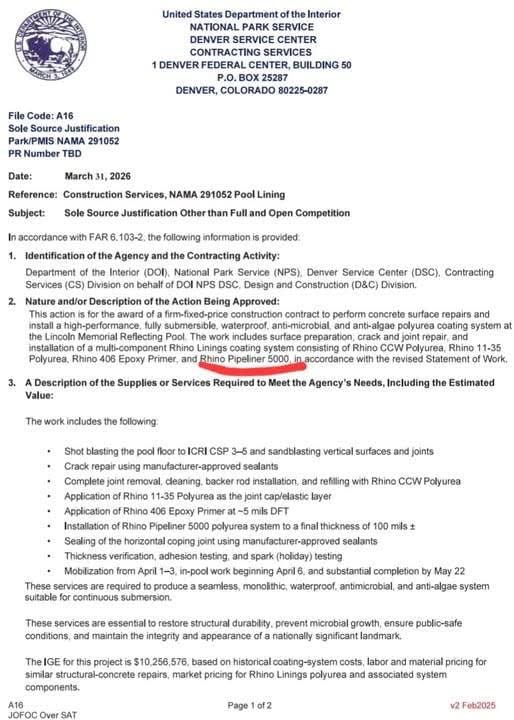
P.S. On the reflecting pool from my friend Zach:
Rhino Pipeliner 5000 is an industrial polyurea/polyurethane formulation primarily designed for enclosed environments like buried pipes and water tanks. It is highly susceptible to UV oxidation from direct sunlight.
Effects of Direct Sunlight
When left unprotected in direct sunlight, the intense UV radiation breaks down the polymer chains of aromatic polyureas like Pipeliner 5000.
Micro-Cracking & Delamination: As the exposed polymer degrades, it becomes brittle, leading to micro-cracking and eventual separation from the substrate.
It is important to note that direct sunlight, heat, and certain chemical treatments can exacerbate material failures. For example, when used in open-air water basins, the combination of harsh sunlight and oxidizers like hydrogen peroxide used for algae control can accelerate the breakdown of the polymer chains.
Just the facts, please
Here's some facts and page to back it up. The page is directly service offering and proposal for work on the reflecting pool.