The Shelbyville Pour
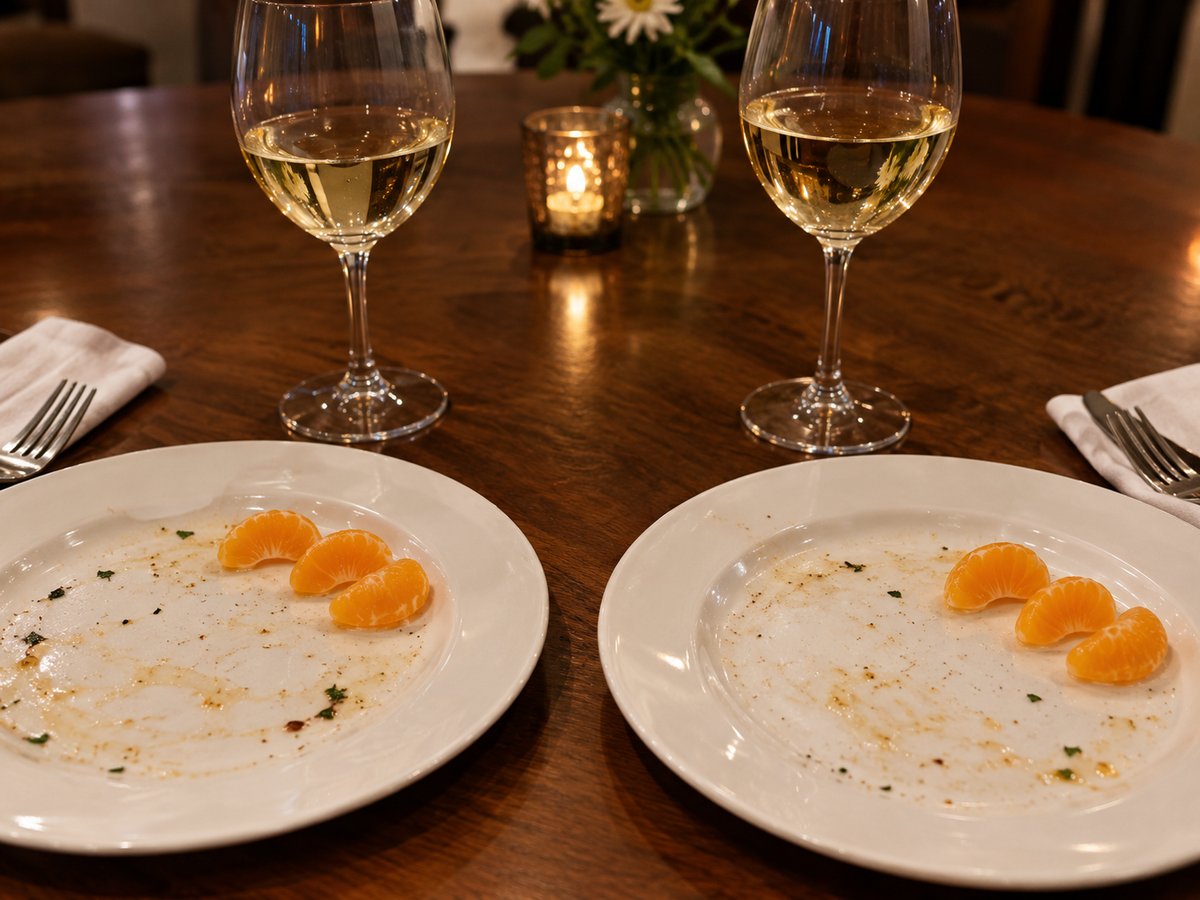
An unforgettable evening of fine dining, questionable garnishes, and creative wine service.
There are certain dining experiences that stay with you forever.
Perhaps it was a spectacular meal overlooking the Mediterranean. Maybe a candlelit dinner in Paris. Or a perfectly prepared steak accompanied by an exceptional glass of wine.
And then there was Shelbyville, Indiana.
For nearly twenty years, my husband and I lived in a small town outside Indianapolis. Shelbyville was a perfectly respectable little community, although I don’t believe anyone was ever in danger of confusing it with the culinary capital of the Midwest.
We had gas stations. We had Walmart. And if you were looking for an unforgettable gastronomic adventure, well, you might want to fill up your tank and drive somewhere else.
But there was one restaurant.
A locally owned, family-operated establishment that had been around for years and enjoyed a reputation as the place to go for a good steak and a nice dinner.
In a town where your other options weren’t exactly competing for Michelin stars, this was apparently our answer to fine dining.
The restaurant was operated by a husband-and-wife team. One handled the cooking, while the other managed the hospitality and marketing.
And I will say this: the hospitality and marketing were quite good.
The food, however, was another matter.
One evening, Dale and I decided to treat ourselves to dinner there.
We were seated in a somewhat cavernous little dining area, complete with a bar toward the back. It had that particular atmosphere that says, “We’re going for intimate and sophisticated, but we may have accidentally landed somewhere between a basement rec room and a medieval wine cellar.”
Nevertheless, we were optimistic.
We ordered our dinners and each requested a glass of Riesling.
Now, I have eaten in some very nice restaurants over the years. I’ve enjoyed meals in France, Italy, and other places where people take food quite seriously.
I also understand that presentation matters.
Apparently, so did the kitchen in Shelbyville.
Because when our dinners arrived, each plate featured an extraordinary decorative flourish.
Three mushy mandarin orange segments.
Three.
Not two. Not four.
Three.
Lying there on the plate like tiny, exhausted survivors of a fruit cocktail catastrophe.
I stared at them.
Were they intended to be eaten? Were they a garnish? Was there some ancient culinary tradition involving precisely three canned mandarin oranges that I had somehow missed during my travels?
And then I noticed something remarkable.
Everybody had them.
Every plate emerging from that kitchen was apparently required to carry its own little orange tribute to fine dining.
Steak? Three oranges.
Chicken? Three oranges.
Whatever else was on the menu? I suspect three oranges.
Perhaps the chef had attended a seminar titled Elevating Your Cuisine Through the Strategic Deployment of Canned Fruit.
I don’t know.
But I do know that those three little orange segments made quite an impression.
The meal itself was fine.
Not wonderful. Not terrible. Just fine.
We ate, enjoyed our conversation, and congratulated ourselves on supporting a local business.
And then came the moment that would secure this restaurant’s place in our family history.
Behind the bar was a gentleman who appeared to be thoroughly enjoying his work.
And by thoroughly, I mean he seemed to have developed a particularly enthusiastic relationship with the beverages.
I’ll leave it at that.
At some point, he decided to venture out from behind the bar and help clear a few tables.
A noble gesture.
As he approached us, I had perhaps three tablespoons of Riesling remaining in my glass.
It had been sitting there for some time, had lost its chill, and was no longer particularly appealing.
Dale still had about a quarter of his glass remaining.
The gentleman looked at me.
“Are you finished with that?”
“Yes,” I replied.
And then it happened.
Without hesitation, without consultation, and with what I can only describe as the confidence of a man performing an act of exceptional customer service, he picked up my glass.
And poured my leftover wine directly into Dale’s glass.
Just like that.
My warm, abandoned, three-tablespoon wine remnant was now happily mingling with my husband’s perfectly respectable Riesling.
No fresh glass.
No inquiry.
No ceremony.
Just a little recycling operation right there at the table.
Waste not, want not.
He seemed quite pleased with himself.
Perhaps he thought he’d saved us money.
Perhaps he believed he’d enhanced Dale’s drinking experience.
Perhaps this was Shelbyville’s answer to the French tradition of blending wines.
A house cuvée, if you will.
Château de Leftovers.
Vintage: Approximately fifteen minutes ago.
Serving temperature: Roomish.
Notes of citrus, with a lingering suggestion of canned mandarin orange.
Whatever his motivation, he completed his little act of hospitality and walked away.
Dale and I looked at each other.
For one brief moment, neither of us said a word.
And then we burst out laughing.
Not a polite little chuckle.
The kind of laughter that comes when something is so completely unexpected, so utterly ridiculous, that your brain needs a moment to process what your eyes have just witnessed.
We couldn’t believe it.
Who does that?
Who walks up to a restaurant table, takes one person’s leftover wine, and pours it into another person’s glass as though performing some kind of sacred sommelier ritual?
Apparently, somebody in Shelbyville.
And thus, a family tradition was born.
The Shelbyville Pour.
Nearly twenty years later, that phrase remains firmly embedded in our household vocabulary.
Whenever an opportunity presents itself to combine the remnants of two drinks, or someone is about to perform a questionable act of beverage management, one of us will inevitably ask:
“Should we do a Shelbyville pour?”
And we laugh all over again.
That’s the wonderful thing about marriage, isn’t it?
After enough years together, you develop your own private language.
A collection of phrases, memories, and ridiculous little references that would make absolutely no sense to anyone else.
You don’t even have to explain them.
Two words, and you’re right back at that table, staring at three mushy mandarin oranges while a very helpful gentleman introduces an entirely new concept in wine service.
I’ve had meals that cost hundreds of dollars and forgotten almost everything about them.
I’ve enjoyed elegant restaurants with linen tablecloths, exquisite food, and professional sommeliers who could tell you which hillside produced the grapes in your glass.
But none of them ever gave me a story quite like this one.
And I suppose there’s a lesson in that.
Sometimes the experiences that become our most treasured memories aren’t the ones that go perfectly.
They’re the ones that go gloriously, hilariously wrong.
The ones that leave us shaking our heads, laughing uncontrollably, and telling the story for the next twenty years.
The restaurant is long gone now, and I have no desire to embarrass the people who owned it. Running a family restaurant is hard work, and they were doing their best to provide something their community appreciated.
But I do hope that somewhere, somehow, that bartender knows he created a legacy.
Not necessarily the legacy he intended.
But a legacy nonetheless.
And should Dale and I ever find ourselves at another restaurant where a server offers to combine our leftover wine, I intend to look that person straight in the eye and say:
“Ah. I see you’ve been trained in Shelbyville.”
Some people leave behind recipes. Others leave behind traditions. This gentleman left behind three tablespoons of warm Riesling and a legend.
And honestly, what more could you ask of a dinner out?
Thank you, as always, for spending a little time with me here at Julie’s Journal.
I hope your week gets off to a wonderful start, filled with good food, good company, and at least one moment that makes you laugh until your sides hurt.
And now I’m curious: Have you ever had a restaurant experience so bizarre that you’re still talking about it years later? I’d love to hear about it.
If this story made you smile, please share it with someone who could use a good laugh. And if you’re not yet subscribed, I’d love to have you join us.
Until next time, enjoy your wine. Preferably from your own glass.
Julie Bolejack, MBA
The Mindful Activist
To subscribe: julies-journal.ghost.io