Where are all the "new factories"?

Where Are All the New Factories?
The investment announcements are real. The promised manufacturing boom has not arrived - at least not yet.
Monday, July 27, 2026
Hello, friends - another day of heavy lifting (getting my mid-summer work out)
If you listen to President Trump, the United States is experiencing an economic transformation unlike anything we have seen before.
Trillions of dollars are supposedly pouring into the country. Companies are returning from overseas. New factories are being announced. American manufacturing, the White House says, is "roaring back."
Some of those announcements are real. Major corporations have pledged billions for semiconductor plants, pharmaceutical production, appliances, automobiles, energy facilities, artificial-intelligence infrastructure, and data centers. Those projects may eventually produce valuable capacity and good jobs.
But an announcement is not a factory. A groundbreaking is not a completed plant. And a promise to create jobs is not the same as workers appearing on a payroll.
When we look at what companies are actually spending to build manufacturing facilities - and how many Americans are actually employed in manufacturing - the picture is far less triumphant.
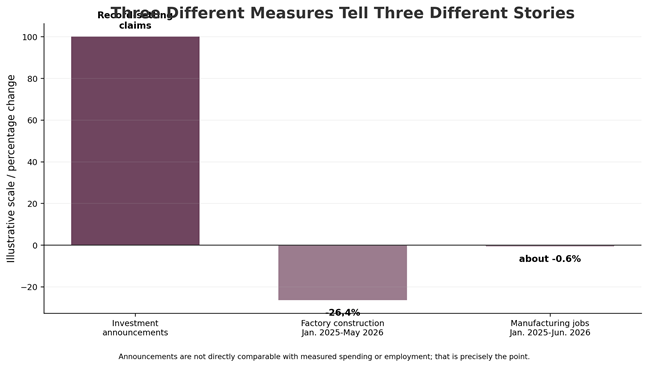
The language of a boom depends heavily on which measure is being discussed.
The announcement economy
The White House has created an investment page crediting Trump's policies with trillions of dollars in new commitments. In April 2025, it claimed more than $5 trillion in investment announcements during his first 100 days and said those commitments would create more than 451,000 jobs.
That is an impressive headline. It is also an unusually broad calculation.
The total combines many different kinds of promises: planned factory expansions, artificial-intelligence data centers, energy projects, purchases of American products, foreign-government commitments, and multiyear corporate spending plans. Some projects were conceived or subsidized before Trump returned to office. Some will unfold over a decade. Some may be reduced, delayed, or never completed.
The Financial Times used a narrower definition and identified more than $900 billion in manufacturing-related commitments from 84 companies between Trump's inauguration and June 2026. That is still substantial. But it also illustrates why the headline number changes depending on what is counted.
There is nothing improper about celebrating a legitimate investment announcement. The problem comes when projected spending is presented as though the money has already been spent and the jobs already exist.
What companies are actually building
The Census Bureau measures the value of construction work actually being put in place. That provides a more grounded view of whether America's factory-building boom is accelerating.
In January 2025, manufacturing construction spending was running at a seasonally adjusted annual rate of approximately $237.5 billion. By May 2026, it had fallen to $174.8 billion.
That is a decline of roughly 26 percent.
The slowdown did not begin from nowhere. Manufacturing construction had surged during the Biden administration, driven heavily by semiconductor, electric-vehicle battery, and clean-energy projects encouraged by the CHIPS and Science Act and Inflation Reduction Act. Spending reached extraordinary levels in 2023 and 2024, making some cooling likely.
But that context does not transform a decline into a boom. The latest Census figures show manufacturing construction down nearly 22 percent from May 2025 alone. The monthly series fell through much of 2025 and continued declining during the first five months of 2026.
New projects may eventually reverse that trend. For now, however, the amount of factory construction actually underway is substantially lower than when Trump returned to office.
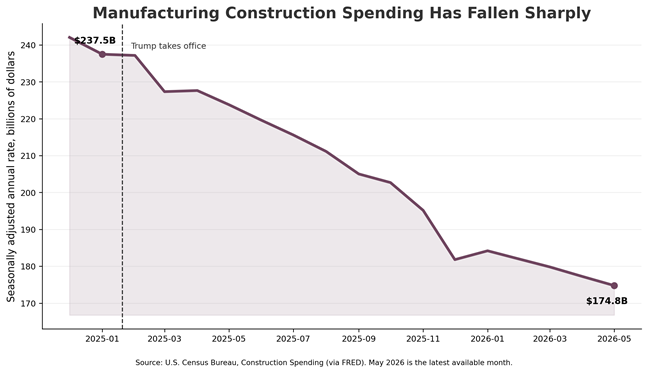
Manufacturing construction spending fell from approximately $237.5 billion in January 2025 to $174.8 billion in May 2026, a decline of about 26 percent.
What happened to the factory jobs?
Then there are the jobs.
According to the Bureau of Labor Statistics, the United States had approximately 12.6 million manufacturing jobs in June 2026. That was 38,000 fewer than one year earlier and roughly 77,000 fewer than around the beginning of Trump's second term.
Manufacturing employment did increase by 3,000 in June, and several recent months have shown signs of stabilization. That deserves to be acknowledged. But a few thousand jobs do not erase the larger decline.
This is also not simply a Trump-era problem. American manufacturing employment has faced decades of pressure from automation, productivity improvements, foreign competition, shifting consumer demand, and the movement of production abroad. A modern factory can produce far more with far fewer workers than the factories many Americans remember.
That is precisely why political promises of a vast return of traditional factory employment should be treated carefully. Building advanced semiconductor plants or automated pharmaceutical facilities may strengthen national security and increase production without restoring millions of assembly-line jobs.
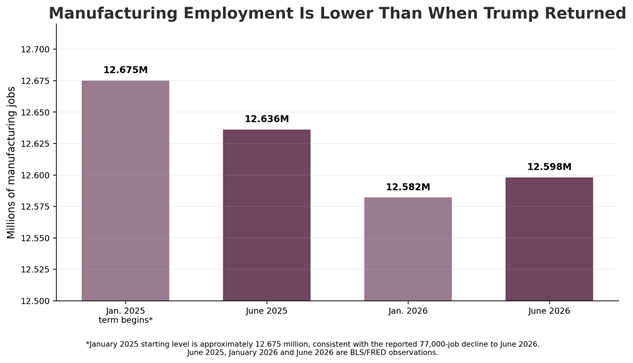
Manufacturing employment has recently stabilized, but it remains below its level at the beginning of Trump's second term.
Why tariffs have not produced an instant renaissance
Tariffs are supposed to change the calculation by making imported goods more expensive and encouraging companies to produce in the United States.
They can help certain protected industries. A steel producer competing with subsidized foreign metal may benefit from higher import barriers.
But manufacturers are also buyers. American companies import steel, aluminum, copper, machinery, electronic components, and other materials that go into products made here. Tariffs can increase their costs, squeeze margins, raise consumer prices, and make American exports less competitive.
Small and midsized manufacturers have repeatedly described another obstacle: uncertainty. Companies making twenty-year investment decisions want to know what materials will cost, which countries will face tariffs, whether exceptions will be granted, and whether the policy will change again next month. When the rules keep moving, some companies wait.
That does not prove every job loss or delayed factory was caused by Trump. Interest rates, weaker demand, automation, and global conditions also matter. But it does mean tariffs cannot automatically be counted as manufacturing victories simply because they were announced.
Promises, pipelines, and present reality
The honest conclusion is not that every investment claim is fictional. It is that the administration is presenting the most flattering measure - future commitments - while measurable present-day outcomes remain weak.
Investment announcements: historically large, although broadly defined.
Manufacturing construction: down sharply.
Manufacturing employment: lower than when Trump returned to office.
Those facts can coexist. Large corporations may genuinely intend to invest while taking years to obtain permits, build facilities, install equipment, and begin hiring. Today's weak numbers do not guarantee failure four years from now.
But they also do not justify declaring victory today.
The test should be results
Every president deserves credit when policies help persuade companies to invest in America. And every president should be judged by results rather than press releases.
How much money was actually spent? How many plants were completed? How much did manufacturing output increase? How many people were hired? What did taxpayers contribute through subsidies, tax breaks, or higher prices? And how many announced projects quietly disappeared?
Those are not partisan questions. They are the questions we should ask whenever any administration claims an economic miracle.
Americans do not work inside investment announcements.
They work inside factories.
And until more of those factories are actually being built and hiring people, the promised manufacturing renaissance remains exactly that: a promise.
Until next time,
Julie Bolejack, MBA
Share and subscribe to avoid the overlords and algorithms: julies-journal.ghost.io
Data Notes
· Manufacturing employment figures are seasonally adjusted and come from the Bureau of Labor Statistics Current Employment Statistics program.
· Construction figures are seasonally adjusted annual rates. They measure the value of construction work put in place, not the total announced cost of future projects.
· The January 2025 manufacturing-employment starting level is approximate. The June 2026 BLS level is 12.598 million, and the Financial Times calculated a decline of about 77,000 jobs since Trump's inauguration.
· Presidential attribution is inherently limited. Projects take years to plan and build, and outcomes reflect laws, subsidies, interest rates, demand, technology, state policies, and decisions made under multiple administrations.
· The newsletter distinguishes among commitments, construction spending, employment, and output. None is a complete measure by itself.
Sources
· U.S. Bureau of Labor Statistics, Employment Situation - June 2026, Table B-1.
· Federal Reserve Bank of St. Louis FRED, All Employees, Manufacturing (MANEMP), updated July 2, 2026.
· U.S. Census Bureau, Monthly Construction Spending, May 2026.
· Federal Reserve Bank of St. Louis FRED, Total Construction Spending: Manufacturing in the United States (TLMFGCONS).
· The White House, Investments; and '100 Days of Investment: $5+ Trillion in New Investment Fuels America's Future,' April 29, 2025.
· The White House, 'Trump Effect: A Running List of New U.S. Investment in President Trump's Second Term,' March 10, 2026.
· Financial Times, 'Donald Trump's pledge to unleash a golden age of US manufacturing sputters,' June 4, 2026.
· Reuters, 'An Indiana town shows two sides of Trump's factory boom,' March 26, 2026.


