24/7 Arlington National Cemetery
Julie’s Journal
On Veterans Day, an Army sentinel at Arlington National Cemetery stopped his patrol and turned toward a group leaving the Tomb of the Unknown Soldier. Defense Secretary Pete Hegseth, his wife and members of his staff had been posing for photographs after the ceremony. As the group broke up, laughter was audible. The sentinel called out, “All visitors will maintain an atmosphere of silence and respect at all times.” A Pentagon spokesman said the soldier had acted correctly and respectfully. (apnews.com, krdo.com)
I’m glad he spoke up. If you’re the secretary of defense, I think you have a particular responsibility to set the example at Arlington. And I keep coming back to one word in what the sentinel said. All.
That moment made me want to understand what the sentinel had been doing before he turned to speak, and what he went right back to doing afterward. I knew about the changing of the guard. I had never stopped to think about what happens when the last visitor leaves.
Twenty-one steps
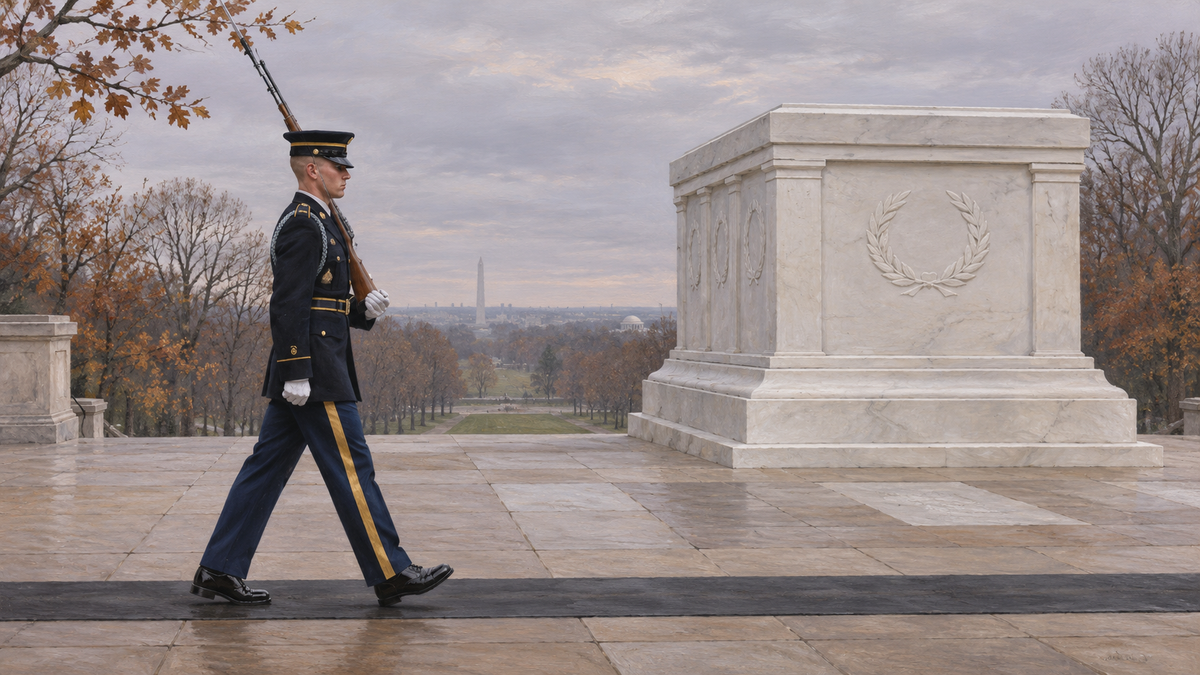
A sentinel walks exactly 21 steps along a black mat beside the Tomb. At the end, the soldier turns east to face the Tomb and holds for 21 seconds. Then the soldier turns to face back along the mat and holds for another 21 seconds before walking 21 steps in the opposite direction. The sequence repeats. The number honors the 21-gun salute, the highest customary military gun salute. (arlingtoncemetery.mil, arlingtoncemetery.mil)
Watch the rifle and you’ll see another deliberate movement. Before walking back across the mat, the sentinel shifts it to the shoulder farthest from the Tomb. That places the soldier between the Tomb and any possible threat. The sentinel also watches over the plaza and can interrupt the walk to address visitors, as the guard did on Veterans Day. (arlingtoncemetery.mil, krdo.com)
What happens when the guard changes
Three soldiers take part in the handoff. There’s the sentinel finishing the watch, the sentinel coming on duty and the relief commander. The commander salutes the Tomb, then turns to the spectators and asks them to stand and remain silent. The incoming sentinel presents an M14 rifle for a white-glove inspection. The commander checks each part of the rifle before joining the two sentinels at the center of the mat. All three salute the Unknowns. (arlingtoncemetery.mil)
At the commander’s direction, the outgoing sentinel passes on the standing orders. The incoming sentinel answers, “Orders acknowledged,” takes position and begins the walk at a cadence of 90 steps per minute. The soldiers who volunteer for this duty face a demanding selection and training process. They study Arlington’s history and learn the locations of nearly 300 graves. They are tested on ceremonial movements, handling the rifle and maintaining their uniforms and equipment. (arlingtoncemetery.mil)
What happens when the cemetery closes
The watch continues. It has been continuous since July 1, 1937, through the night, on holidays and in rain, snow and summer heat. The first guards were posted in 1926 and served during daylight hours. The Army’s 3rd U.S. Infantry Regiment, known as The Old Guard, took over in 1948. The Society of the Honor Guard says there are procedures for conditions such as lightning and dangerous winds so the soldiers can stay safe while the watch continues. (army.mil, tombguard.org)
During public hours, the guard changes on the hour from October 1 through March 31 and every half hour from April 1 through September 30. After the cemetery closes, Arlington’s centennial guide says the guards relieve one another every two hours. That’s the detail I keep thinking about. In the middle of the night, with the cemetery closed and the plaza empty, another soldier arrives to take the watch. (arlingtoncemetery.mil, arlingtoncemetery.mil)
The soldier who came home from France
The Tomb began with a single burial. In October 1921, four caskets holding unidentified American soldiers were brought from military cemeteries in France to the town of Châlons-sur-Marne. An American sergeant named Edward F. Younger, himself a veteran of World War I, placed white roses on one of the caskets. That was how he chose the soldier who would be brought home to Arlington. (arlingtoncemetery.mil)
The casket crossed the Atlantic aboard the USS Olympia. About 90,000 people came to pay their respects while the soldier lay in state at the U.S. Capitol. He was buried at Arlington on November 11, 1921, three years after the armistice that ended the fighting in World War I. As the funeral began, Americans across the country observed two minutes of silence. (arlingtoncemetery.mil)
The grave was originally covered by a simple marble slab. The monument we see today was completed in 1932. Three figures carved into the marble represent Peace, Victory and Valor. On the side facing the amphitheater are the words, “Here rests in honored glory an American soldier known but to God.” (arlingtoncemetery.mil, army.mil)
Three Unknowns and an empty crypt
On Memorial Day in 1958, two more unidentified Americans, one from World War II and one from the Korean War, were buried in crypts beside the original Tomb. A Vietnam War Unknown was buried there on Memorial Day in 1984. Nearly 14 years later, at the request of a family that believed he might be their loved one, his remains were exhumed. DNA testing confirmed his identity. He was Air Force First Lieutenant Michael Joseph Blassie, a pilot shot down in 1972. His family had him reburied at Jefferson Barracks National Cemetery in St. Louis. (arlingtoncemetery.mil)
The Vietnam crypt remains empty. In 1999, it was rededicated to all American service members still missing from that war. I think about what it must have meant to the Blassie family to finally have a grave with Michael’s name on it. And I think about the families who are still waiting for that same certainty. There is room at Arlington for both stories. (arlingtoncemetery.mil)
A century ago, Americans stopped for two minutes as a soldier they could never know by name was laid to rest. Today, a sentinel asks visitors for a little of that same silence. It gives the person standing next to us room to remember someone whose name we may never know, either.
Thank you for reading Julie’s Journal. If someone you know would appreciate the story behind those 21 steps, I hope you’ll share this with them. And if someone shared this with you, I’d love to have you subscribe. Julies-journal.ghost.io
Julie Bolejack, MBA
The Mindful Activist