Wait. NASA named a billion-dollar space telescope after the woman who interrogates murder suspects on television?
Wrong Nancy Grace. 😂
By Julie Bolejack
Something extraordinary happened Sunday morning.
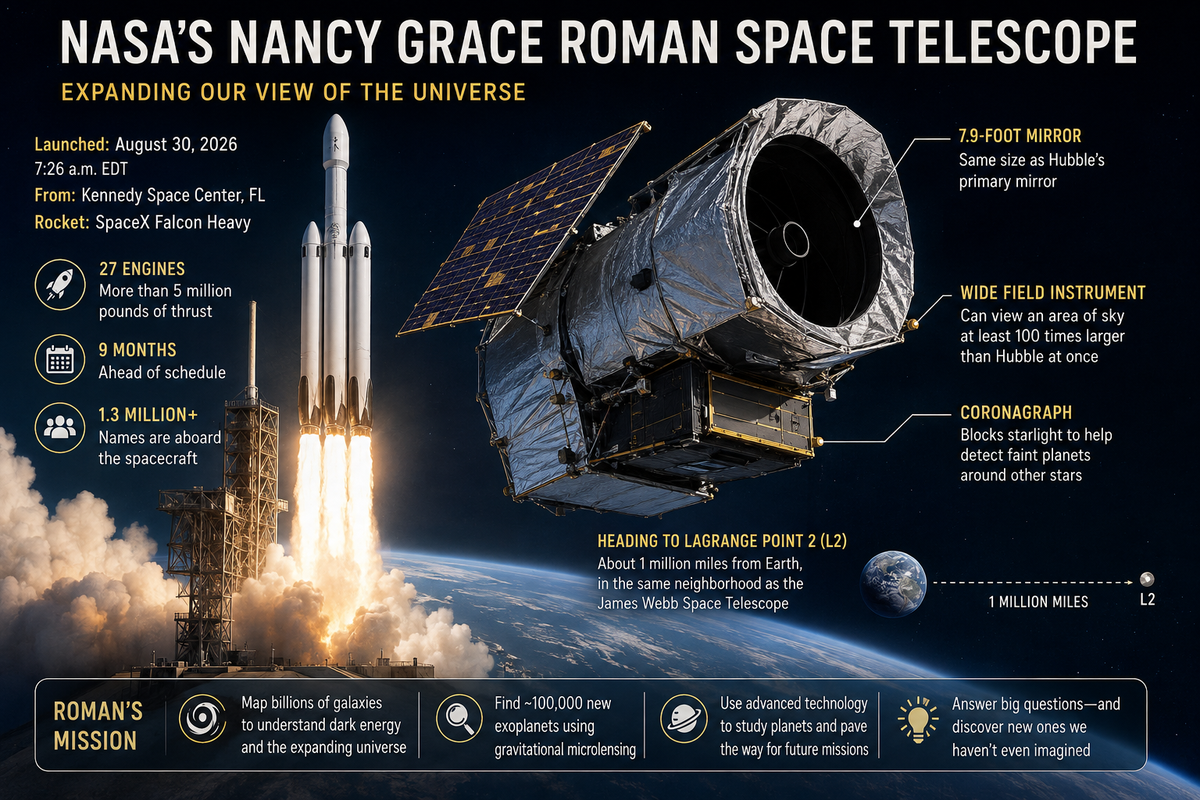
At 7:26 a.m. Eastern time, a SpaceX Falcon Heavy rocket lifted off from Kennedy Space Center carrying one of the most remarkable scientific instruments human beings have ever built.
Twenty-seven engines fired.
More than five million pounds of thrust pushed the rocket away from Earth.
And tucked inside was the Nancy Grace Roman Space Telescope.
If you haven’t heard much about Roman yet, you probably will.
Because this telescope may fundamentally change what we know about the universe.
And I mean the really small questions.
Things like:
What is most of the universe actually made of?
Why is the universe expanding faster instead of slowing down?
How many planets are out there?
Are solar systems like ours common—or are we the weird family on the cosmic block?
You know. Little things.
First, Who in the World Was Nancy Grace?
When I first heard “Nancy Grace telescope,” I confess my mind briefly went somewhere entirely different.
That Nancy Grace is not this Nancy Grace.
Dr. Nancy Grace Roman was an astronomer born in 1925 who became NASA’s first chief astronomer and its first female executive.
And getting there was not exactly a smooth ride.
As a girl, she was told that science wasn’t really a suitable career for women.
Which, historically speaking, has been an excellent way of motivating certain women.
Roman earned a Ph.D. in astronomy from the University of Chicago and eventually joined NASA in 1959, only months after the agency itself had been created.
She became one of the strongest advocates for putting telescopes in space, above Earth’s atmosphere.
Most famously, she fought for the telescope that eventually became Hubble.
She helped bring scientists together. She worked with engineers. She argued for funding. She dealt with Washington.
In other words, she did perhaps the most difficult job in astrophysics:
She convinced Congress.
Her colleagues eventually began calling her the “Mother of Hubble.”
Nancy Grace Roman died in 2018 at age 93.
Now her name is heading nearly one million miles from Earth.
I think she would have enjoyed that.
Hubble With Peripheral Vision
Here is where Roman gets really interesting.
Its main mirror is 7.9 feet across—the same diameter as Hubble’s primary mirror.
But Roman can see a patch of sky at least 100 times larger than Hubble can see at once while maintaining remarkably sharp resolution.
Think about that.
Imagine Hubble looking at the universe through a beautifully polished keyhole.
Roman walks into the same room, opens the French doors and says:
“Have we considered looking at ALL of this?”
That ability changes astronomy.
Hubble has given us magnificent, incredibly detailed portraits of relatively small areas of the cosmos.
Roman is designed to survey enormous sections of the sky with that kind of precision.
Its Wide Field Instrument is essentially a roughly 300-megapixel infrared camera.
But calling it a camera is a little like calling the Large Hadron Collider a science project.
Roman will repeatedly photograph enormous regions of space and allow astronomers to compare what changes over time.
NASA expects its surveys to examine billions of galaxies.
Billions.
At some point numbers become so large that our brains simply file them under Good heavens and move on.
And Then There Is Dark Energy
This may be Roman’s greatest scientific mission.
Everything we can see—stars, planets, trees, Labradors, coffee cups, you and me—is made from ordinary matter.
But ordinary matter accounts for only a small fraction of the universe.
The rest appears to be dominated by two things scientists still don’t completely understand:
dark matter and dark energy.
Dark matter doesn’t emit light, but we can see its gravitational effects.
Dark energy is even stranger.
In the late 1990s, astronomers discovered something astonishing.
The universe isn’t merely expanding.
Its expansion is accelerating.
Something appears to be pushing the universe apart.
Scientists call it dark energy.
Which is essentially the scientific equivalent of saying:
“We have absolutely no idea what this stuff is, but clearly it needs a name.”
Roman will map galaxies across enormous distances and enormous stretches of cosmic history.
Scientists can then study how galaxies formed, how matter clumped together and how the expansion of the universe changed over billions of years.
That could help us understand what dark energy actually is.
Or—and this is the fun part—it could reveal that some of our current theories are wrong.
Science loves being right.
But great science gets really interesting when nature says:
Actually, no.
Roman Is Also Going Planet Hunting
Roman has another assignment.
Find worlds.
Lots of them.
NASA estimates that Roman’s surveys could uncover roughly 100,000 previously unknown exoplanets—planets orbiting stars beyond our solar system.
One method it will use is called gravitational microlensing.
Einstein showed us that mass bends spacetime.
So when one star passes almost perfectly in front of another from our viewpoint, the gravity of the closer star can bend and magnify the light from the background star.
If a planet happens to be orbiting that foreground star, it can create another tiny blip in the light.
Roman can detect those blips.
Meaning we can find planets we cannot actually see.
This is one of those moments when I would like everyone to stop complaining about teenagers looking at their phones.
Human beings figured out how to detect an invisible planet thousands of light-years away because its gravity briefly distorted light coming from another star.
We’re doing okay.
And Roman May Actually Photograph Other Worlds
Roman carries another fascinating piece of technology called a coronagraph.
Stars are incredibly bright.
Planets are incredibly dim.
Trying to photograph a planet next to its star is something like trying to photograph a firefly sitting beside a stadium spotlight.
Roman’s coronagraph is designed to block the overwhelming glare of the star so scientists can detect the much fainter objects around it.
This particular instrument is primarily a technology demonstration, but if it performs as hoped, it could help pave the way for future telescopes capable of directly studying Earth-like worlds.
And someday those telescopes might examine the atmospheres of distant planets looking for signs that something lives there.
Think about that sentence for a moment.
Roman Is Going to Have a Very Famous Neighbor
Roman is now beginning a journey toward a region called Lagrange Point 2, or L2, roughly one million miles from Earth.
The James Webb Space Telescope operates around this same region.
L2 is a gravitationally convenient location where a spacecraft can remain aligned with Earth as both travel around the Sun.
So we are essentially developing a small scientific neighborhood about a million miles away.
Webb is already there.
Roman is moving in.
I assume somebody will eventually organize a homeowners association.
Roman will spend several months traveling, deploying equipment, cooling, calibrating and undergoing tests before serious science begins.
Its primary mission is planned for at least five years, and it was designed so that an extended mission could potentially continue for another five.
Even more fascinating: Roman was designed to be refuelable if future technology allows us to service spacecraft that far away.
Here’s What I Love Most About This
Roman is expected to make enormous discoveries.
But NASA scientists freely acknowledge something even more exciting:
They don’t know what Roman will find.
Every time humans have built a dramatically better way of looking at the universe, we have discovered things we weren’t looking for.
Galileo pointed a telescope toward Jupiter and found moons.
Hubble transformed our understanding of galaxies, black holes and the age and expansion of the universe.
Webb has shown us galaxies from astonishingly early periods of cosmic history.
And now Roman is going to look at huge portions of the universe with extraordinary depth and clarity.
There will almost certainly be things hiding in those images that nobody predicted.
That may be Roman’s greatest promise.
Not merely answering our questions.
Giving us entirely new questions.
More Than a Million of Us Went Along
And there is one last detail I absolutely love.
Before launch, NASA invited members of the public to submit their names to travel aboard Roman.
More than 1.3 million people did.
Those names were stored on a memory card attached to the spacecraft.
So somewhere aboard this extraordinary machine heading toward a point nearly a million miles from Earth are the names of ordinary people who simply wanted to say:
Send a tiny piece of me along.
There is something wonderfully human about that.
We are curious creatures.
We have always wanted to know what is beyond the next hill, across the ocean, above the clouds and behind the stars.
And sometimes, despite everything happening down here on our messy little planet, we manage to work together long enough to build something magnificent.
A woman who was once told women weren’t supposed to become scientists helped make Hubble possible.
Now a telescope bearing her name has left Earth to investigate the nature of the universe itself.
Nancy Grace Roman is going to the stars.
And somewhere out there—among billions of galaxies, thousands of possible new worlds, dark matter we cannot see and dark energy we cannot explain—there are answers waiting for us.
Maybe even answers to questions we haven’t thought to ask yet.
And I don’t know about you, but on a Sunday morning when the world can sometimes feel awfully small and discouraging, watching 27 engines ignite and send human curiosity roaring toward the universe felt pretty darn good.
Sometimes it’s worth looking up.
Julie Bolejack, MBA
The Mindful Activist
If you enjoyed this journey beyond our little corner of the universe, subscribe to Julie’s Journal and come back for more. Around here, curiosity doesn’t have an expiration date—and apparently, neither does our capacity to be amazed.
Julies-journal.ghost.io


