Just When You Thought You’d Never Have to Think About This Again
By Julie Bolejack
There are phrases I have found myself saying far too often over the past ten years.
I never thought I’d see that.
How is that even possible?
Surely that can’t happen here.
Who would have imagined this?
I can’t believe we’re actually talking about this.
And perhaps the most dangerous one of all:
That could never happen.
We have crossed so many lines that once seemed uncrossable that I’ve begun to wonder whether one of the lessons of this strange period in American history is simply this:
Maybe we need to stop saying never.
I had another one of those moments today.
I came across information about how to survive nuclear fallout.
And I stopped.
Nuclear fallout?
Really?
We’re doing this again?
Because I am a child of the 1950s. I remember the Cold War world. I remember when nuclear weapons occupied a very different place in the American imagination.
There were children being taught what to do in the event of an atomic attack. There were fallout shelters. There was the strange idea that hiding beneath a school desk might somehow provide meaningful protection from Armageddon.
Then life moved on.
The Soviet Union collapsed. The Cold War ended. And although nuclear weapons certainly didn’t disappear, most of us stopped thinking about them while making coffee in the morning.
I certainly wasn’t expecting, at this stage of my life, to find myself reading instructions about radioactive fallout.
But there I was.
And something surprised me.
The information was extraordinarily practical.
Not survivalist stuff.
Not bunkers in Montana stocked with beans and ammunition.
Basic information from public-health authorities that could actually save lives.
So I kept reading.
And then I started checking.
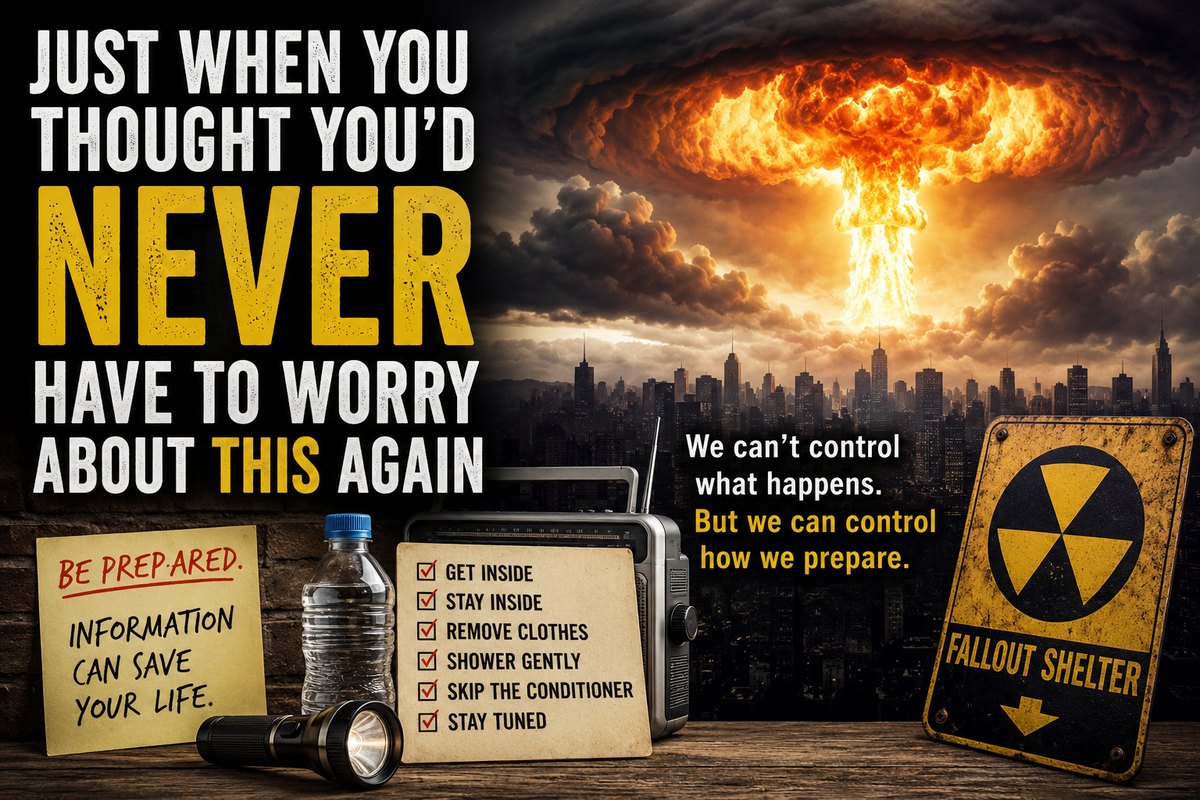
Get Inside. Stay Inside. Stay Tuned.
That is essentially the message from the Centers for Disease Control and Prevention during a radiation emergency.
If radioactive fallout were occurring and you were outside, one of the worst instincts might be the most human one:
Get in the car. Go home. Find the children. Find your spouse. Find your parents.
Don’t.
The CDC specifically warns that cars provide poor protection from radioactive material. Get inside the nearest substantial building as quickly as possible.
If you’re already inside, stay there.
And if someone you love is at school, a hospital, a nursing home or another facility, don’t automatically go out looking for them. Those facilities would receive their own emergency instructions.
The CDC recommends moving toward the middle of a building or into a basement, putting as much material—walls, concrete, earth—as possible between you and the radioactive material outside.
Close windows and doors.
Turn off fans, air conditioners or heating systems that pull outside air into the building, if possible.
Close fireplace dampers.
Bring the pets inside.
And then stay put until authorities tell you otherwise.
Why?
Because radiation exposure decreases with time, distance and shielding.
And radioactive fallout becomes less dangerous as time passes.
CDC guidance says remaining sheltered for at least the first 24 hours can provide important protection while authorities determine what has happened and where fallout has traveled.
That is remarkably simple information.
And I wonder how many Americans know it.
Then Take Off Your Clothes
This one surprised me.
If you’ve been outside where radioactive material may have been present, removing your outer layer of clothing can eliminate up to 90 percent of radioactive material from your body.
Ninety percent.
That might be one of the most useful pieces of emergency information I’ve learned in years.
Remove the clothing carefully so you don’t shake radioactive dust into the air.
Place it in a plastic bag or other sealable container if one is available.
Put it somewhere away from people and pets.
Then wash yourself.
And Here Is Where Conditioner Becomes the Enemy
Take a warm shower.
Use plenty of water.
Use soap.
Wash your hair with shampoo.
But don’t scrub yourself raw.
The goal isn’t to exfoliate your way through a nuclear emergency.
In fact, the CDC specifically advises against scrubbing, scratching or scalding the skin because damaged skin can provide another pathway for contamination.
Wash gently and let the water carry particles away.
And then comes perhaps the strangest beauty advice I will ever give you:
Skip the conditioner.
Seriously.
The CDC specifically says do not use hair conditioner after radioactive contamination because conditioner can cause radioactive material to bind to the hair.
Apparently nuclear fallout is the one emergency in which we’re going to have to accept frizz.
I can live with that.
Literally.
Put on clean clothes afterward—preferably clothing that had been stored inside a drawer or closet.
What About Food and Water?
Food that was already inside is generally safe.
Canned foods, boxed foods and sealed containers are safe. Food in your refrigerator or freezer that hasn’t spoiled is safe. If a container may have been exposed, wipe the outside before opening it.
And here’s an important distinction I didn’t know before researching this:
Tap water can be used to wash radioactive contamination from your body even if officials haven’t yet determined that it is safe to drink.
For drinking, the CDC recommends bottled water until authorities have tested the public supply.
And boiling potentially contaminated water doesn’t solve the problem. Boiling water kills microorganisms. It does not magically remove radioactive material.
Again: something worth knowing.
Why Am I Writing About This?
Because something has changed.
As I write this on August 31, the United States has been at war with Iran for six months.
And today there has been another exchange of fire.
That doesn’t mean nuclear war is imminent.
It doesn’t mean President Trump is preparing to use a nuclear weapon.
In fact, in reporting today about the renewed confrontation, Reuters reports that Trump dismissed the idea of using nuclear weapons against Iran.
That’s important, and I want to be very clear about it.
There are alarming claims circulating online about nuclear escalation, and some are being presented far more confidently than the evidence warrants.
We should not turn fear into fact.
But neither should we pretend the world around us is perfectly normal.
The war has continued far longer than initially predicted. Iran remains capable of military retaliation. The Strait of Hormuz remains a source of enormous international tension. American military resources have been stretched by the conflict. And nuclear weapons are increasingly part of international rhetoric well beyond Iran, as tensions involving Russia and North Korea continue as well.
So I don’t think learning what to do during a radiation emergency is hysteria.
I think it’s preparedness.
There is a difference.
I Never Thought I’d Have to Know This
That’s the part that stayed with me.
I never thought I’d need to know that hair conditioner could make radioactive contamination worse.
I never thought I’d need to know that removing my coat and clothes could eliminate most external radioactive material.
I never thought I’d need to know that getting into my car and racing toward someone I love could be exactly the wrong thing to do.
I never thought I’d need to know that the safest thing might simply be:
Get inside.
Stay inside.
Stay tuned.
But perhaps there is a broader lesson here.
For years now, Americans have watched events unfold that many of us once described as impossible, unimaginable or unthinkable.
And every time something extraordinary happens, we move the boundary of what we consider possible a little farther.
Maybe I never thought I’d see this isn’t enough anymore.
Maybe we should replace it with something more useful:
If something unlikely happened, would I know what to do?
That isn’t living in fear.
I keep a fire extinguisher in my house without spending every evening expecting the kitchen to burst into flames.
We wear seat belts without expecting an accident every time we leave the driveway.
We know where the exits are on an airplane while fully expecting the plane to land safely.
Preparedness isn’t pessimism.
Preparedness is information.
And information gives us something fear never does:
A plan.
So share this one.
Tell your children.
Tell your grandchildren.
Remember the basics.
Get inside.
Move toward the center or basement.
Close the outside air off as much as possible.
If you’ve been exposed, carefully remove your outer clothing.
Bag it.
Shower gently with soap and shampoo.
Don’t scrub.
And for heaven’s sake, skip the conditioner.
Then put on clean clothes, stay inside and listen to emergency authorities.
I sincerely hope none of us ever needs any of this.
I hope ten years from now someone finds this column and thinks:
Julie, you really worried about some strange things back in 2026.
I would be absolutely delighted to be wrong.
But I’ve lived long enough now to become suspicious of one particular phrase:
That could never happen.
We’ve said it before.
And just when we thought we’d never have to think about something like this again—
here we are.
Julie Bolejack, MBA
The Mindful Activist
Thank you, as always, for reading Julie’s Journal. If this made you think—or taught you something you didn’t know—please share it with someone you care about. Sometimes the most important information isn’t the information we expect to need.
It’s the information we hope we never do.