Paying Attention
Something happened to me last week.
Nothing dramatic. No revelation. No crisis. No moment that would make the opening scene of a film about a woman who finally figures it out.
Just this:
I was walking outside and I stopped.
Not because I had to. Not because my phone died or my knee gave out or someone called my name.
I just… stopped.
And I looked at a tree.
A specific tree. One I have almost certainly walked past dozens of times without registering its existence. And I stood there for what was probably ninety seconds — which, in the currency of modern attention spans, is roughly equivalent to reading War and Peace — and I just looked at it.
And it was extraordinary.
Not the tree, necessarily. Though the tree was doing its absolute best.
The extraordinary part was the noticing.
The actual, deliberate, unhurried noticing of a thing that had been there all along.
We have a attention problem.
Not the kind that gets diagnosed and medicated, though that’s real too. The broader kind. The civilizational kind. The kind where we have access to more information, more stimulation, more content than any humans in history — and somehow, in the middle of all of it, we have become spectacularly bad at actually seeing anything.
We scroll. We scan. We skim.
We consume approximately 74 gigabytes of information per day — that’s a real number, someone studied this, they clearly had concerns — and retain approximately enough to win one question on a Tuesday night pub quiz.
We are drowning in input and starving for perception.
And here’s the inconvenient thing about that.
You cannot be a Mindful Activist — you cannot be a conscious, engaged, fully present human being in a complicated world — if your attention is permanently fractured into thirty-seven browser tabs and a notification from an app you downloaded once and forgot about.
Attention is not just a cognitive function.
It is a moral act.
What you pay attention to is what you are telling the world matters.
What you notice shapes what you feel. What you feel shapes what you do. What you do shapes — slowly, cumulatively, over time — who you are and what kind of world you’re helping to create.
Which means the ninety seconds I spent looking at that tree were not wasted.
They were practice.
Practice in the radical, quietly countercultural act of being present to something without immediately needing it to be useful, shareable, or optimized for engagement.
Just real.
Just here.
Just worth a moment of genuine attention.
I am not suggesting you become a person who stares at trees professionally. Though honestly, worse career paths exist.
I am suggesting something smaller and more sustainable:
Pick one thing today. Just one.
Your coffee before it gets cold. The face of someone you love. The particular quality of light at whatever time of day you happen to be reading this. The sound of something ordinary.
Look at it. Really look.
Not through your camera. Not through the frame of how you might describe it later. Not while simultaneously composing a text message in your head.
Just you and the thing.
For ninety seconds.
And notice what happens.
Not to the thing.
To you.
Because here’s what I have learned, slowly and with great resistance, about the practice of paying attention:
The world does not get smaller when you slow down to look at it.
It gets bigger.
Stranger.
More intricate and more beautiful and more worth fighting for than the scroll ever told you it was.
And if we are going to fight for it —
We need to be able to see it first.
Just… look.
Julie Bolejack,
The Mindful Activist
🎲 Bonus: Random Info You Didn’t Know You Needed
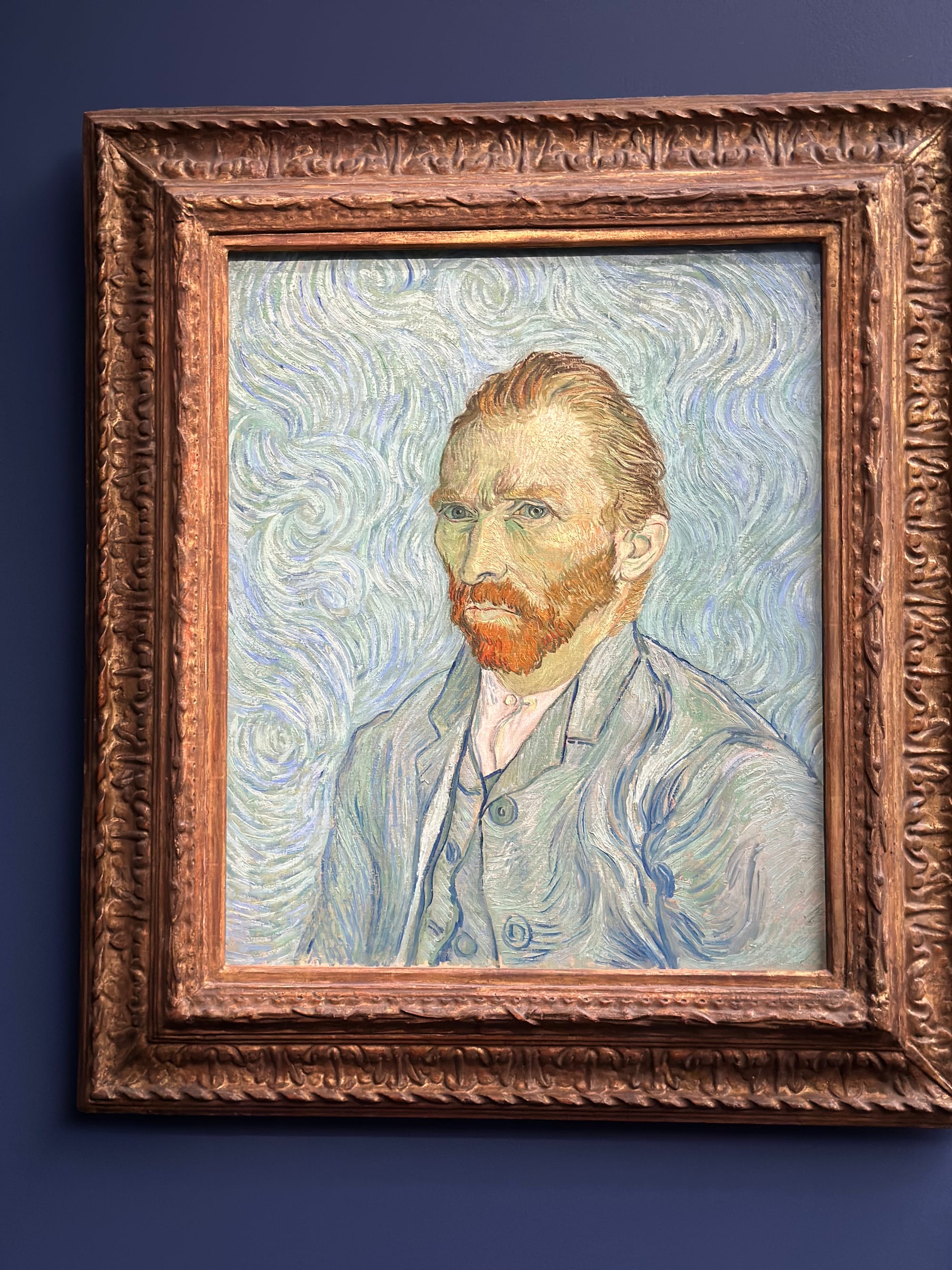
Vincent van Gogh sold exactly one painting during his lifetime.
One.
In a career that produced over 900 paintings and more than 1,100 drawings, the grand total of commercial success he lived to see was a single canvas — The Red Vineyard — sold in 1890 for 400 francs, roughly equivalent to about $2,000 today.
He died four months later.
His work now sells for hundreds of millions of dollars. Portrait of Dr. Gachet fetched $82.5 million in 1990. Irises sold for $53.9 million. The Sunflowers series is, at this point, practically a cultural institution.
He spent his entire life paying attention to light.
To color.
To the precise, trembling quality of an ordinary world that most people walked past without looking.
Nobody was watching.
He looked anyway.