Thanksgiving: A National Exercise in Culinary Optimism
Julie’s Journal | Wednesday, November 25, 2026
In which we attempt to cook a bird, maintain family relations, and survive another American holiday.
Thanksgiving is a peculiar American institution. We spend three days preparing a meal, forty minutes eating it, two hours cleaning up after it, and the remainder of the year remembering what went wrong.
And yet, every November, we approach the occasion with the optimism of a man buying his seventeenth lottery ticket.
This year will be different.
It will not.
Somewhere in America tomorrow, a woman will discover that the little bag containing the turkey’s internal organs has been roasting inside the bird for five hours. She will quietly remove it, dispose of the evidence, and accept compliments on the turkey’s unusually rich flavor.
Her secret will go with her to the grave.
Somewhere else, a man will announce that he has watched a video on how to deep-fry a turkey and therefore requires no further instruction. His wife will move the cars out of the driveway, check the homeowners insurance, and notify the neighbors.
Marriage, after all, is largely a matter of knowing when to intervene and when to evacuate.
A Thanksgiving From My Own Family Archives
My mother, God rest her soul, was responsible for one of the more memorable culinary experiences of my lifetime.
She was making macaroni and cheese and decided to enrich the dish with a little sour cream. She retrieved the sour cream container from the refrigerator and proceeded accordingly.
Now, in those days, a sour cream container was not necessarily an indication that sour cream resided within it. It was merely a vessel whose original purpose had long since been forgotten. It might contain leftover gravy, green beans, bacon grease, or something that had been awaiting identification since the Eisenhower administration.
In this particular instance, it contained a tropical fruit dip intended to accompany dessert.
Nobody discovered the error until we were seated at the table and had collectively taken our first bites.
There is a particular expression that crosses the human face when the brain has been promised cheddar cheese and the tongue reports back from the Caribbean.
It takes a moment for the two departments to reconcile their findings.
But Mother was not finished with us.
She had also prepared homemade noodles, a considerable undertaking, and had them sitting in a large pan on the stove. Unfortunately, the bottom of the pan had begun burning, imparting a generous smoky flavor to the entire contents.
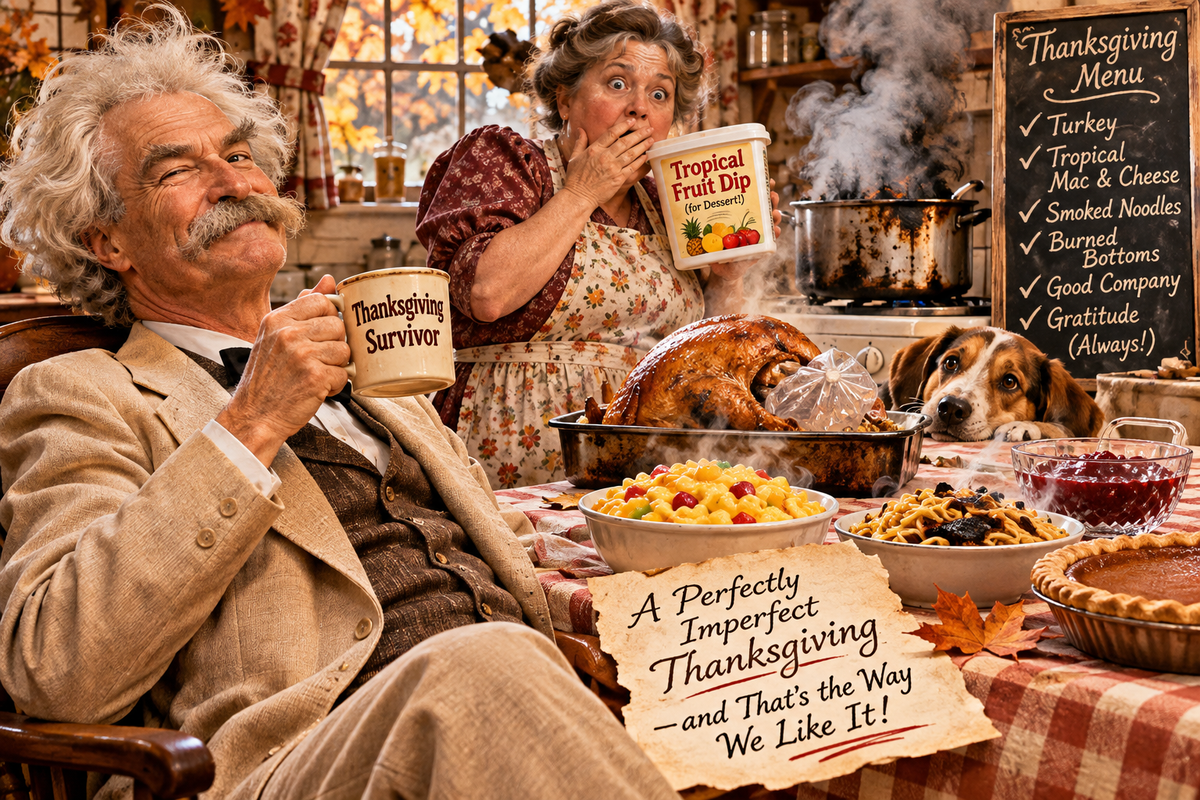
And so, long before fusion cuisine became fashionable, my mother served us tropical macaroni and cheese accompanied by smoked homemade noodles.
Today, some ambitious chef in New York would charge forty-seven dollars for that combination, describe it as an exploration of cultural boundaries, and receive a favorable review in a culinary magazine.
We just wanted the rolls.
The Great American Thanksgiving Experiment
Thanksgiving is the one day of the year when otherwise intelligent people attempt to prepare fourteen dishes requiring seven different oven temperatures using one oven.
The mathematics alone should discourage us.
There is also the matter of the turkey thawing. Every year, someone discovers on Thanksgiving morning that their turkey remains in a condition suitable for exhibition at a natural history museum.
It is not merely cold. It is prehistoric.
Then there is the person who brings a new recipe to Thanksgiving dinner without having previously tested it.
This is not cooking. This is human experimentation without informed consent.
And we must not forget the cranberry sauce. There are two schools of thought regarding cranberry sauce in America: those who believe it should be made from fresh cranberries and those who believe it should emerge from a can with the manufacturer’s architectural details still visible.
These two groups have coexisted for generations with considerably more civility than our political parties.
Perhaps there is something to be learned from that.
Getting There Is Half the Misery
Of course, before many Americans can enjoy Thanksgiving dinner, they must first get to Thanksgiving dinner.
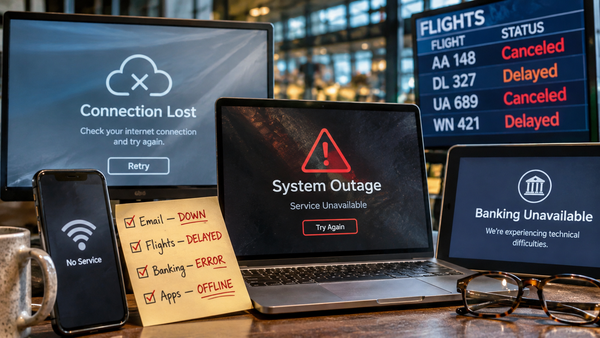
Airports will be filled with people who paid extraordinary sums of money for the privilege of sitting on the floor near an electrical outlet.
Families traveling by automobile will discover that the shortest distance between two points is apparently under construction.
Someone will forget the pie. Someone will forget their medication. Someone will remember, approximately ninety miles from home, that they may have left the garage door open.
And somewhere in the Midwest, a family will spend twenty minutes debating whether to stop at a rest area, only to discover that everyone needs to stop immediately after passing it.
Civilization has made remarkable advances, but the family road trip remains largely unimproved.
And Then There Are the Relatives
Every Thanksgiving gathering has at least one person who considers the dinner table an appropriate venue for resolving the nation’s political, economic, religious and constitutional difficulties.
This individual generally begins with the words, “Well, I’ll tell you what’s wrong with this country.”
No one has asked.
My recommendation this year is that whenever someone introduces a controversial subject, immediately ask them whether they would like more gravy.
If that fails, offer pie.
If pie fails, there is little hope for the individual, and you should concentrate your efforts on protecting the remaining guests.
There is no constitutional requirement that you settle the future of the Republic between the mashed potatoes and the pumpkin pie.
What We Really Have to Be Thankful For
All joking aside, I hope tomorrow you will grant yourself and everyone around you a little grace.
If the turkey is dry, there is gravy.
If the rolls are burned, there is butter.
If the macaroni and cheese tastes like a tropical vacation, consider yourself an international traveler.
If your flight is delayed, your relatives are irritating, your house isn’t spotless, or your dinner doesn’t resemble the photographs on Pinterest, remember that none of these things constitutes a national emergency.
There are people we wish were still sitting at our tables. There are voices we would give almost anything to hear again. There are family recipes we would gladly eat, burned or otherwise, if only we could have the person who made them back for one more afternoon.
I would happily sit down to another helping of my mother’s tropical macaroni and cheese and smoked noodles.
What a wonderful thing it would be to laugh about it with her.
So be grateful that you are here. That you have been granted another day on this rather extraordinary planet. That there are still things to laugh about, people to love, stories to tell, and memories yet to be made.
Don’t exhaust yourself pursuing perfection tomorrow. We still have the remainder of 2026 to get through, and judging by its performance thus far, I suspect we ought to conserve our strength.
Eat well. Laugh loudly. Forgive generously. Take the leftovers.
And remember, the difference between a Thanksgiving disaster and a cherished family tradition is generally about twenty years.
Happy Thanksgiving, everyone!
May your turkey be thawed, your gravy be lump-free, your relatives be reasonably sedated by carbohydrates, and may the contents of your sour cream containers be precisely what their labels suggest.
With love, laughter, and a healthy respect for properly labeled leftovers,
Julie Bolejack, MBA
The Mindful Activist
Share and to subscribe:
julies-journal.ghost.io