“The Gorilla Looked Straight at Us… and Everything We Believe About Ourselves Quietly Fell Apart.”
There are voices that narrate the world.
And then there are voices that help us remember we belong to it.
David Attenborough has spent more than seven decades doing something deceptively simple: he has shown us the Earth. Not as a backdrop. Not as scenery. But as a living, breathing system—complex, fragile, and astonishingly beautiful.
He did not begin as a crusader. He began as a storyteller.
In the early years, with the BBC, he traveled to places most of us would never see. Remote islands. Dense jungles. Frozen landscapes. He brought back images, yes—but more importantly, he brought back perspective.
Over time, something shifted.
The stories became warnings.
Not dramatic, not alarmist. Attenborough has never needed theatrics. Just clarity. A coral reef bleaching. A forest thinning. A species quietly disappearing. He has always trusted that if people truly saw what was happening, they would feel it. And if they felt it, perhaps they would care.
And if they cared, perhaps they would act.
That is his legacy.
Not just that he documented the natural world—but that he translated it into something we could understand emotionally. He made science feel personal. He made distance feel immediate.
And now, even in his later years, his voice carries the same quiet authority.
Recently, his work on Netflix has once again brought the story of gorillas into living rooms across the world. The footage is extraordinary, of course. It always is.
But what lingers is not the cinematography.
It is the presence.
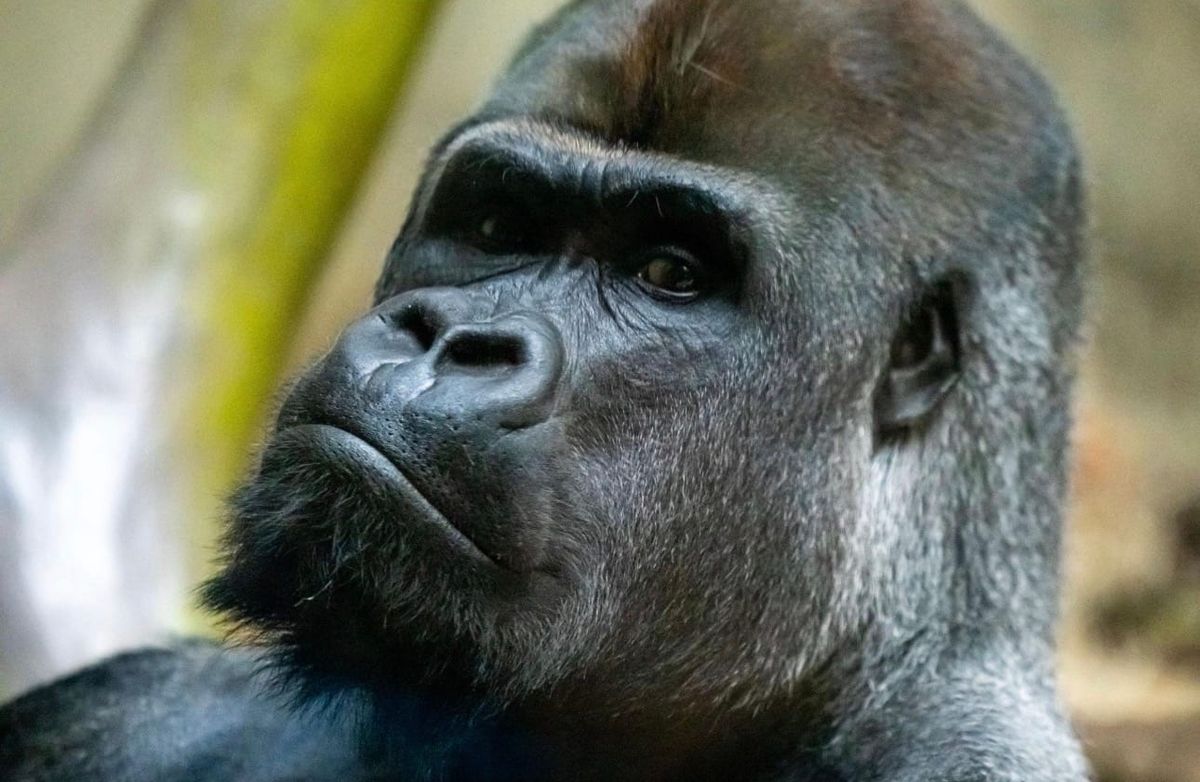
A gorilla looking directly into the camera—not as an animal being observed, but as a being aware. Present. Social. Intelligent. Gentle in a way that unsettles our assumptions.
There is something disarming about that moment.
Because it quietly dismantles the hierarchy we’ve constructed.
We are not separate from this world. We are participants in it.
And that understanding did not begin with cameras.
It began, in part, with a woman who chose to sit still long enough to be accepted.
Dian Fossey did not arrive in Rwanda with a production crew or a global audience. She arrived with curiosity—and a kind of stubborn devotion that would shape the course of conservation.
She lived among mountain gorillas in the Virunga Mountains. Not observing from a distance, but immersing herself in their world. She learned their behaviors. Their rhythms. Their trust.
And in doing so, she revealed something we had not fully understood.
They were not the violent creatures we had imagined.
They were families.
They mourned. They protected. They played. They formed bonds that, once seen, could not be unseen.
Fossey’s work did more than expand scientific knowledge. It shifted perception.
And perception, as it turns out, is everything.
Because we protect what we understand.
And we understand what we allow ourselves to feel connected to.
Her life was not easy. It was marked by isolation, by conflict, and ultimately by violence. She was murdered in 1985, at the age of 53, in the very place she had committed herself to protecting.
There is something both tragic and quietly profound about that.
She gave her life to something that could not thank her.
At least, not in words.
But perhaps in survival.
Today, mountain gorillas still exist. Not in the numbers they once did. Not without ongoing threat. But they are here. And part of that is because one woman refused to look away.
Attenborough, in his own way, has carried that same refusal forward.
Different method. Different temperament. Same underlying truth:
Look closely.
Care deeply.
Do not turn away.
The combination of Fossey’s immersion and Attenborough’s storytelling has created something powerful—a bridge between worlds. One lived. One shared. Both essential.
We often think of legacy in terms of achievements. Awards. Recognition. Milestones.
But perhaps the more meaningful measure is this:
Did you help people see differently?
Did you expand their sense of connection?
Did you leave behind not just information—but awareness?
By that measure, both Attenborough and Fossey have done something extraordinary.
They have widened the circle.
And perhaps that is what we are all being asked to do, in our own lives.
To widen our own circles.
To look at the spaces we inhabit—our homes, our yards, our communities—not as separate from nature, but as part of it. To notice the small things. The bird that returns each morning. The way light moves across a garden. The quiet intelligence in places we once overlooked.
It does not require travel to Rwanda.
It requires attention.
And maybe, just maybe, that is where change begins.
Not in grand gestures.
But in the simple act of seeing—and choosing not to look away.
With appreciation for those who have helped us see more clearly,
Julie Bolejack, MBA
Thank you for being here, for reading, and for continuing to engage with these reflections. If this piece resonated, feel free to share it with someone who might need a quieter reminder of their place in the world. And if you haven’t yet subscribed, you can join us at julies-journal.ghost.io—away from the algorithms, the noise, and the rush.
A small, unrelated note on something I’ve been thinking about:
We spend a surprising amount of our lives arranging things.
Furniture. Schedules. Words. Even our own identities.
We adjust, refine, reposition—often in search of something that feels just right.
But occasionally, the most meaningful shift doesn’t come from rearranging.
It comes from removing.
Taking something away.
A chair that no longer fits the space. An obligation that quietly drains energy. A belief that has outlived its usefulness.
There is a clarity that comes with subtraction.
A kind of quiet that allows something more honest to emerge.
Not empty.
Just… less crowded.
And perhaps, in that space, something essential has room to return.
🙏
#/share


