The Hidden Wounds That Shape Your Adult Life
As I continue writing my books, I find myself learning far more than I ever expected — not only about the world around me, but about myself.
Writing has become a form of excavation. Sometimes I begin with an idea I want to explore, only to discover that beneath it are old assumptions, hidden wounds, inherited beliefs, or quiet truths I had never fully examined before. The process of writing asks me to sit still long enough to notice patterns — in people, in culture, in relationships, and in my own life.
What surprises me most is how universal so many of these experiences are.
The things we privately believe are “just us” are often deeply human. Our fears. Our coping mechanisms. Our need for approval. Our exhaustion. Our longing to feel safe, seen, valued, and loved. So many adults are quietly carrying emotional burdens they do not fully understand, often believing their struggles are simply personality traits rather than learned survival patterns.
The deeper I go into my own reflection and research, the more I realize how many people are walking through life shaped by wounds they never chose and never fully recognized.
That realization has changed the way I write.
I no longer want to simply tell stories or share opinions. I want to share understanding. I want to offer language for experiences many people have felt but could never quite explain. If something I learn helps another person feel less alone, more self-aware, more compassionate toward themselves, or more willing to seek healing, then the writing has served a purpose beyond me.
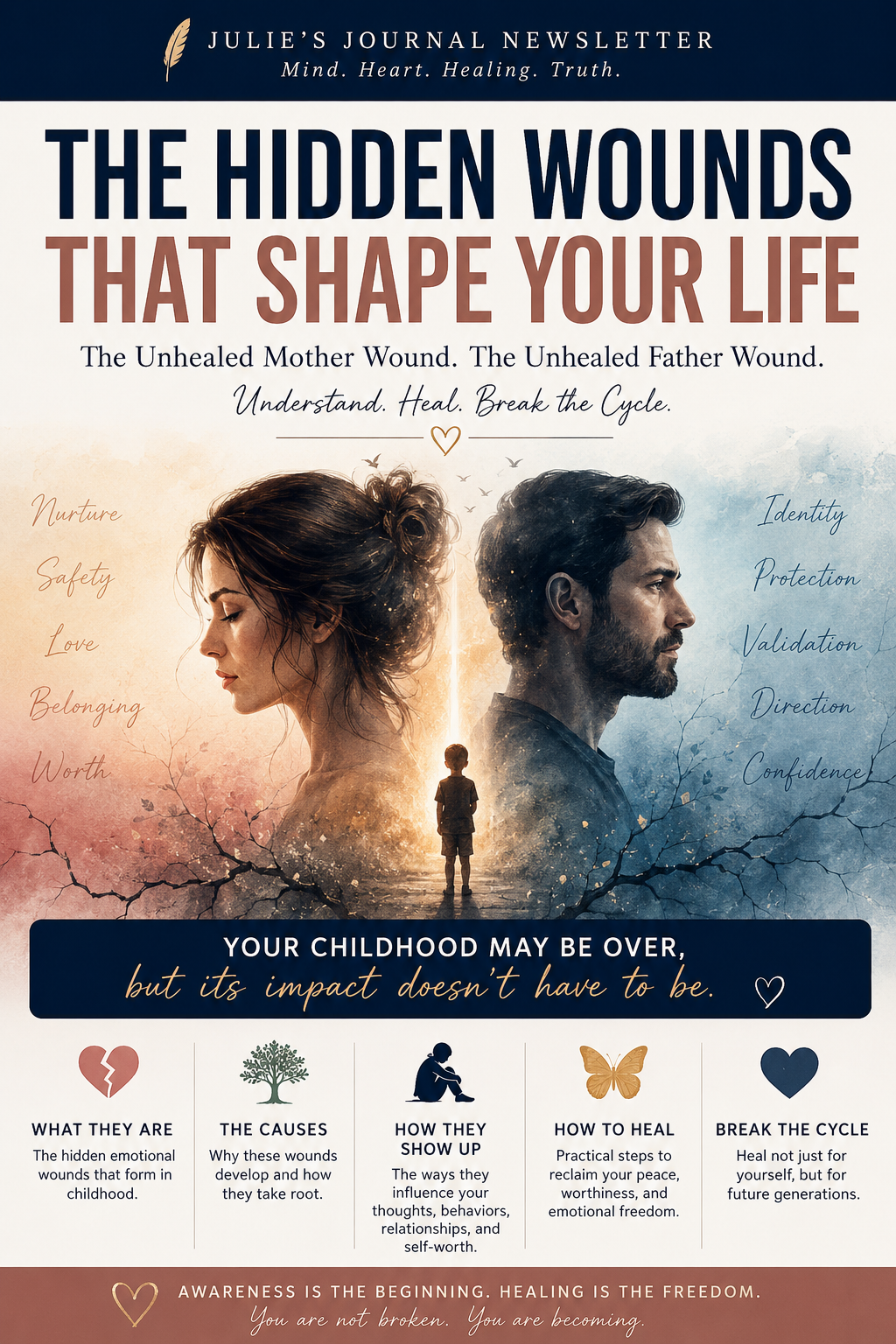
This week, I found myself reflecting deeply on the unhealed mother wound and father wound — how they form, how they quietly shape adulthood, and how many of us are still being influenced by emotional blueprints created decades ago.
And perhaps most importantly, how healing remains possible.
Many of us reach adulthood believing our struggles are simply personality traits. We call ourselves “independent.” “Sensitive.” “Anxious.” “Perfectionistic.” “Avoidant.” “People pleasers.” We blame ourselves for patterns we do not fully understand.
But often, beneath those patterns, are old emotional wounds formed long before we had language for them.
Two of the deepest are the unhealed mother wound and the unhealed father wound.
These are not about assigning blame or turning parents into villains. Most parents carry wounds of their own. Many loved their children deeply while still lacking the emotional tools, awareness, stability, or healing necessary to fully nurture them. Understanding these wounds is not about condemnation. It is about clarity.
Because what remains unhealed in childhood often quietly shapes adulthood.
The mother wound is often connected to emotional safety, nurturance, belonging, emotional regulation, and worthiness. The father wound is often connected to identity, protection, validation, confidence, direction, and permission to take up space in the world.
When either relationship is fractured, inconsistent, emotionally absent, controlling, unpredictable, or emotionally immature, a child adapts in order to survive emotionally. Those adaptations can later become deeply ingrained adult patterns.
An unhealed mother wound may develop when a mother is emotionally unavailable, overly critical, enmeshed, neglectful, narcissistic, depressed, anxious, controlling, volatile, addicted, or unable to provide consistent emotional attunement. Sometimes the wound is created not through cruelty, but through emotional absence. A child may grow up physically cared for while emotionally unseen.
Children naturally internalize this.
If the mother was cold, inconsistent, overwhelmed, or emotionally rejecting, the child often concludes:Something must be wrong with me.
As adults, these individuals may struggle with chronic self-worth issues, anxiety, perfectionism, abandonment fears, emotional overreactivity, people pleasing, or difficulty regulating emotions. Many become hyper-attuned to the emotional states of others because they learned early that safety depended on monitoring moods and avoiding conflict.
Some adults with mother wounds struggle to trust women or maintain healthy female friendships. Others become caretakers to everyone around them while neglecting themselves entirely. Some constantly seek reassurance but never fully believe it. Others emotionally shut down because vulnerability once felt unsafe.
The mother wound can also manifest physically and psychologically through burnout, exhaustion, chronic guilt, overfunctioning, or a persistent feeling of never being fully loved or emotionally held.
One particularly painful manifestation is the inability to self-soothe. Children normally learn emotional regulation through a parent’s calm and consistent presence. Without that experience, adults may later feel emotionally flooded by stress, rejection, conflict, or uncertainty because they never fully developed an internal sense of emotional safety.
The father wound manifests differently, though it can be equally profound.
A father wound often develops when a father is absent, emotionally unavailable, harsh, critical, authoritarian, addicted, emotionally immature, inconsistent, volatile, disengaged, or physically present but emotionally disconnected. Sometimes the father is admired externally but inaccessible internally.
Many adults with father wounds become driven achievers. As children, they unconsciously learned that love, approval, or attention had to be earned. Achievement became survival. Success became identity.
From the outside, they may appear highly competent, ambitious, and independent. Internally, however, they often carry deep fears of inadequacy, rejection, failure, or not being enough.
Some become perfectionists who cannot rest. Some constantly seek validation from authority figures, bosses, or romantic partners. Others rebel against authority entirely because authority never felt safe or trustworthy.
A father wound may also lead to difficulty trusting men, difficulty receiving love, fear of vulnerability, emotional guardedness, or attraction to emotionally unavailable partners. The nervous system tends to recreate what feels familiar, even when it is painful.
Children who experienced emotionally distant fathers often grow into adults who unconsciously chase unavailable people, hoping to finally earn the love that once felt unreachable.
Others become fiercely self-reliant because depending on others once led to disappointment.
Many adults carry both wounds simultaneously.
The woman who constantly overgives while secretly fearing abandonment.The man who achieves endlessly while feeling emotionally disconnected.The adult who cannot relax because their nervous system has never fully experienced emotional safety.The person who struggles to identify their own needs because they spent childhood adapting to everyone else’s.
These wounds do not always look dramatic from the outside.
Sometimes they look like:high achievement, constant busyness, humor, caretaking, control, avoidance, hyper-independence, over thinking, difficulty resting, fear of intimacy, fear of conflict, difficulty setting boundaries or an inability to believe they are lovable without performing.
One of the hardest truths is that wounded children often become highly functional adults.
People praise the very survival mechanisms that are quietly exhausting them.
The perfectionist is admired. The caretaker is appreciated. The hyper-independent person is respected. The emotionally numb person is called “strong.”
But survival is not the same as healing.
Healing begins with awareness.
Not blaming. Not endlessly reliving childhood. Not turning parents into monsters.
Simply understanding the emotional blueprint that shaped us.
Healing often requires grieving: the parent we had, the parent we needed, and the emotional experiences we never fully received.
That grief can feel uncomfortable because many people were taught to minimize their pain:“They did the best they could. “Others had it worse.” “I should just move on.”
But acknowledging emotional wounds is not betrayal. It is honesty.
Addressing these wounds often involves therapy, trauma-informed counseling, journaling, support groups, mindfulness practices, nervous system regulation work, healthy relationships, boundary development, and learning self-compassion. It may also involve recognizing patterns we once normalized.
Healing the mother wound may involve learning: how to nurture ourselves, how to emotionally regulate, how to stop abandoning ourselves for others, and how to believe we are worthy of love without performance.
Healing the father wound may involve learning: how to trust ourselves, how to stop tying worth to achievement, how to receive love safely, how to feel emotionally secure, and how to take up space without apology.
For many people, healing also means understanding that their parents’ wounds were often inherited. Trauma, emotional neglect, emotional immaturity, and dysfunctional relationship patterns frequently pass through generations until someone consciously interrupts them.
That interruption is difficult work.
But it is sacred work.
Because unhealed wounds do not disappear simply because we ignore them. They often show up in our marriages, parenting, friendships, careers, nervous systems, and inner dialogue.
The goal is not perfection.The goal is awareness, compassion, and freedom.
Freedom from constantly proving. Freedom from emotional survival mode. Freedom from carrying childhood pain into every adult relationship.
Many people spend decades believing they are broken when in reality they are wounded.
And wounds can heal.
Not instantly. Not neatly. But gradually, through honesty, support, reflection, courage, and the willingness to understand ourselves more deeply.
If these wounds are shaping your life, your relationships, your peace, or your ability to fully experience joy, please do not dismiss them. Self-awareness is not weakness. Seeking help is not failure. Understanding yourself may be one of the most compassionate and life-changing things you ever do.
Sometimes healing begins simply by finally telling yourself the truth:What hurt me mattered. And I deserve to heal from it.
Julie Bolejack, MBA
The Mindful Activist
If this resonated with you, share it with someone who may also be quietly carrying old emotional wounds. And if you are struggling beneath patterns you cannot seem to change alone, consider reaching out for support. Healing does not mean erasing the past. It means no longer allowing the past to unconsciously control your future.
Subscribe to Julie’s Journal at julies-journal.ghost.io to avoid the algorithms, censors, and digital overlords and receive thoughtful reflections on reinvention, healing, identity, and staying human in complicated times.


