The Light You Almost Missed

There is a particular kind of exhaustion that doesn’t come from doing too much.
It comes from feeling too much.
The noise. The outrage. The constant pull to stay informed, react, respond, stay vigilant.
I live there too. Every day.
And yet—somewhere alongside all of that—I’ve been trying to make room for something else.
Not escape. Not denial. Just… noticing.
The small, steady act of enjoying something anyway.
Nature when it decides to behave. Music that slips in and softens the edges. Art that asks nothing from me except to look.
And that’s how I found myself standing in a quiet corner of the Indianapolis Museum of Art at Newfields, in front of a very small painting by Rembrandt van Rijn.
A name we all know.
A painter I had, if I’m being honest, mostly ignored.
Because when I’ve been lucky enough to visit great museums, I’ve tended to drift toward the familiar comfort of Claude Monet and Pierre-Auguste Renoir—light, color, softness. Beauty that announces itself.
Rembrandt does not announce himself.
He waits.
And for years, I walked right past him.
But this time, I didn’t.
I stood there a little longer than usual. Long enough to feel something shift.
Because what looks, at first glance, like a “dark painting”… isn’t dark at all.
It’s deliberate.
Rembrandt lived in the 1600s during the Dutch Golden Age—a period bursting with trade, wealth, and artistic experimentation. But what made him extraordinary wasn’t just his technical skill. It was how he saw people.
Not idealized. Not polished. Not arranged for approval.
Seen.
He painted merchants, elders, himself—again and again—through youth, success, failure, bankruptcy, grief. Over 80 self-portraits, each one less interested in appearance and more interested in truth.
And technically? He did something revolutionary.
He mastered light by embracing darkness.
There’s a term for it—chiaroscuro—the dramatic contrast between light and shadow. But that phrase doesn’t quite capture what he did with it.
He didn’t just use light to illuminate a face.
He used darkness to hold the emotion.
In a Rembrandt painting, the shadows aren’t empty. They’re full. They carry weight. They create depth, tension, humanity. The light doesn’t flood the scene—it arrives carefully, touching only what matters.
Your eye is guided, not overwhelmed.
It’s restraint. It’s intention. It’s storytelling without a single word.
And perhaps most remarkably—he was doing this long before it became widely understood or replicated by others.
When many artists were still focused on perfection and symmetry, Rembrandt was leaning into imperfection, into the human condition itself.
Which brings me back to that small painting in Indianapolis.
It’s remarkable, really, that we have one here at all. The Old Masters collection at Newfields exists because of thoughtful acquisitions and donors, including families like the Clowes family, who believed that great art should live here—not just in the major capitals of the world.
And because of that, I had an unexpected encounter on an ordinary afternoon.
One that quietly sent me down a path.
Because of course, once you start paying attention, you realize how much there is to see.
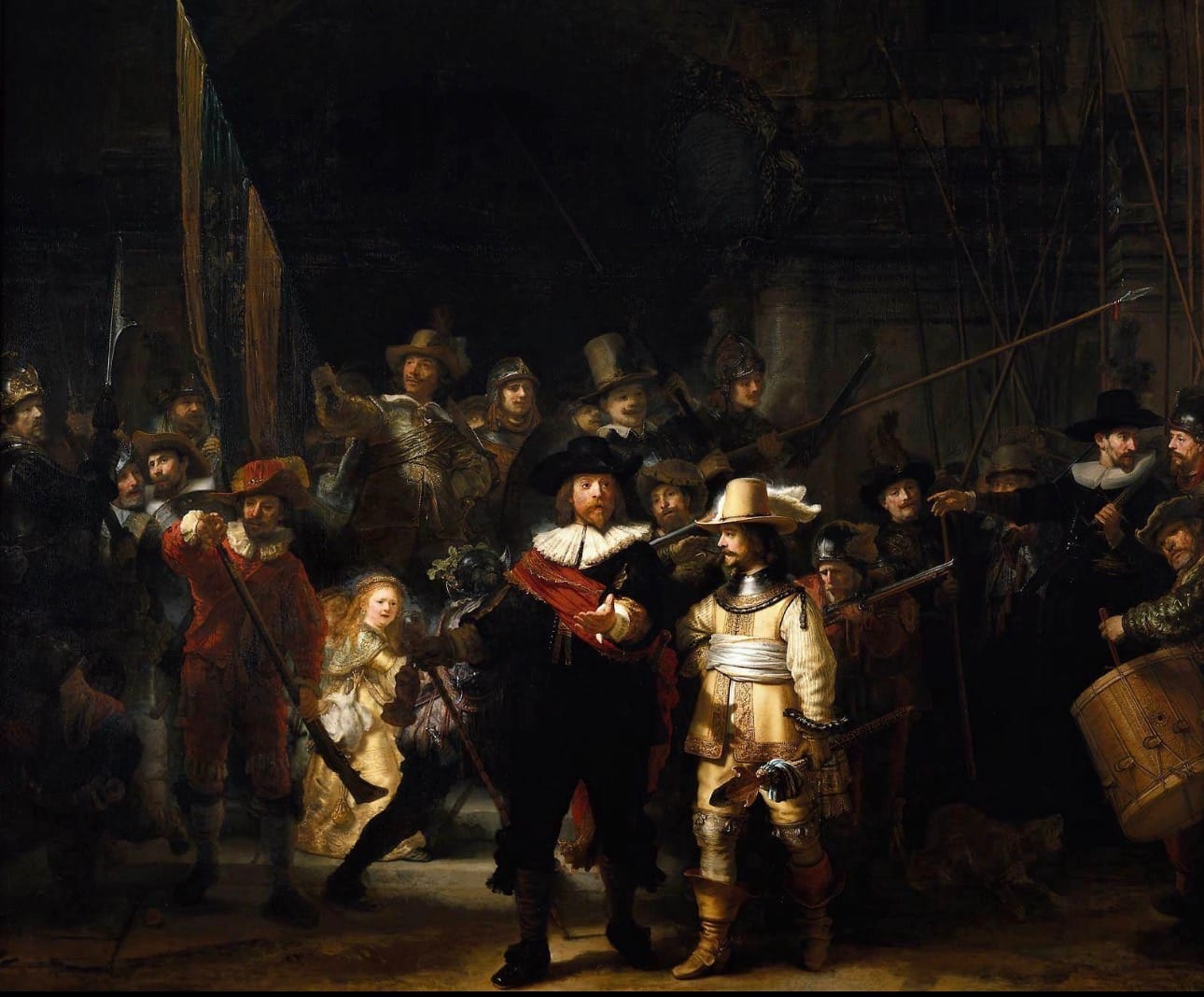
The Rijksmuseum houses the largest collection of Rembrandt’s work, including his most famous painting, The Night Watch.
A painting I now very much want to stand in front of. 2027 Goal!
Not because it’s famous.
But because I suspect it will do what that small painting here did.
Slow me down. Pull me in. Ask me to look more carefully.
And maybe that’s the point of all of this.
We live in a time that rewards immediacy. Reaction. Volume.
Rembrandt offers the opposite.
He asks for patience. For attention. For a willingness to sit with what isn’t immediately bright or easy.
To trust that there is something worth seeing… even in the shadows.
Especially in the shadows.
And I’ve been thinking about how much that applies to daily life right now.
Because yes—there is plenty to be upset about. Distracted by. Concerned over.
But there is also this quieter layer available to us.
A walk outside. A piece of music. A painting we almost didn’t stop to see.
Moments that don’t fix anything.
But remind us that not everything is broken.
I’m not suggesting we turn away from what matters.
I’m suggesting we expand what we allow to matter.
Rembrandt didn’t paint a world without darkness.
He showed us how to see within it.
And that feels… useful.
More than useful, actually.
Necessary.
So this is me, midweek, gently suggesting something:
Find one thing this week that asks you to slow down.
Look at it longer than you normally would. Resist the urge to move on too quickly.
You might be surprised by what reveals itself.
Thank you, as always, for being here with me while I wander a bit—through ideas, through questions, through unexpected discoveries like this one.
I hope you’ll find a few of your own.
And if you do, share them. With your family. With a friend. These small moments of noticing—they travel farther than we think.
If this kind of reflection resonates with you, I’d be honored if you’d subscribe to Julie’s Journal and share it with someone who might need a quieter voice in a very loud world. Julies-journal.ghost.io
And if you haven’t yet, my book Bloom Again: A Memoir of Reinvention is available now on Amazon! The next book in the series, Now What, arrives this June.
We’re just getting started.
With gratitude, Julie Bolejack, MBA
The Mindful Activist
P.S. “The Night Watch” (1642) by Rembrandt van Rijn is one of the most famous paintings in the world—and it’s even more powerful in person than in reproduction.
It hangs in the Rijksmuseum in Amsterdam, where it dominates the gallery with its scale and energy.
A few details that make it extraordinary:
- It’s not actually a night scene—the dark appearance comes from centuries of varnish that aged and dimmed the painting.
- The full title is The Militia Company of Captain Frans Banning Cocq, and it captures a civic guard group preparing to move out—not posing stiffly, as was typical.
- Rembrandt broke convention by creating movement, drama, and light—notice how your eye is drawn to the captain in black and the lieutenant in yellow.
- The young girl glowing in the background is symbolic, not just decorative—she carries visual clues tied to the militia.
Standing in front of it, what strikes most people is how alive it feels. It’s not a portrait—it’s a moment unfolding. I liken it to today with so many of us..we are THE WATCH!
If you’re connecting this to your recent discovery of Rembrandt, this painting is essentially his manifesto: light as storytelling, not just illumination.