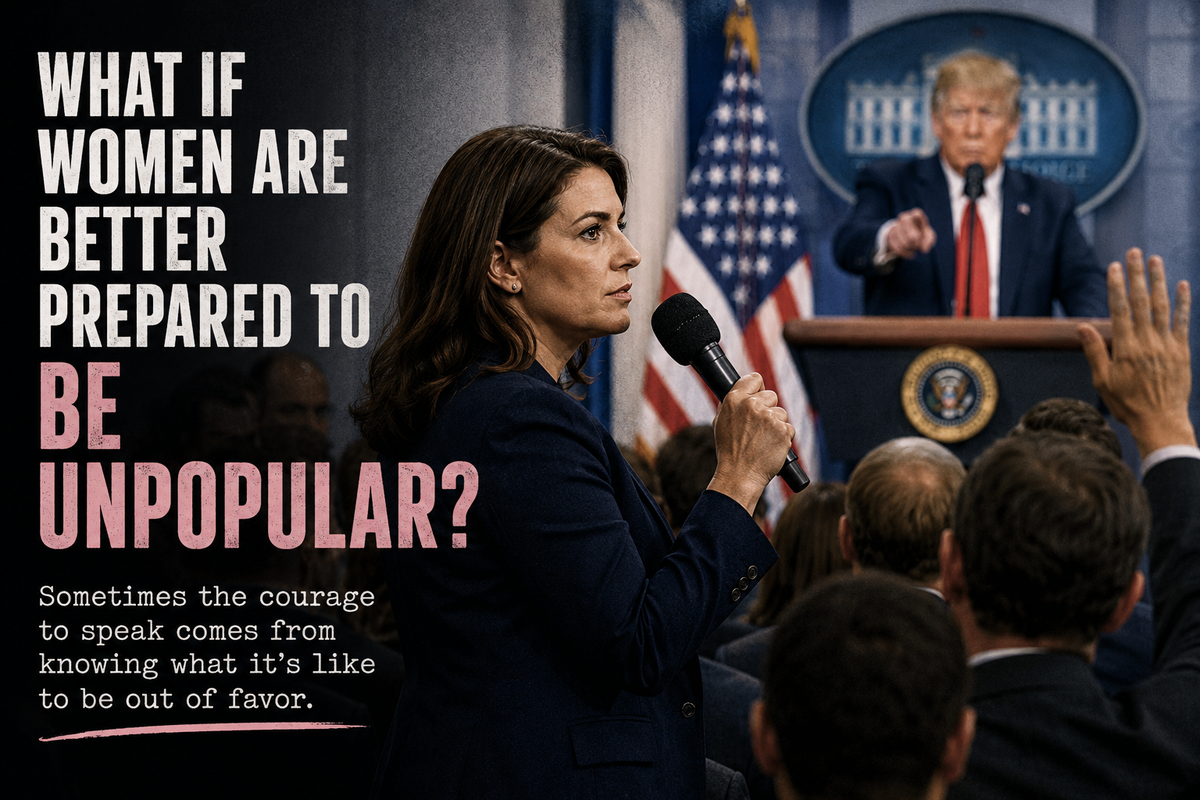
What If Women Are Better Prepared to Be Unpopular?
By Julie Bolejack
I’ve been noticing something.
And once I noticed it, I couldn’t stop noticing it.
In this strange and increasingly intimidating political moment, when speaking the wrong words can bring the wrath of the President of the United States down upon a journalist, politician, business leader or member of his own party, an awful lot of people seem to be choosing their words very carefully.
Sometimes painfully carefully.
But I’ve also noticed something else.
A surprising number of the people willing to ask the uncomfortable question, challenge the premise, push back or simply refuse to be intimidated are women.
And it made me wonder:
Are women, in some strange way, better prepared to be unpopular?
I mentioned this to my husband, Dale, and he immediately offered the simplest explanation.
“What have they got to lose?”
I laughed.
And then I thought: Well, damn.
There may actually be something to that.
We’ve Had Practice
I want to be careful here.
I’m not suggesting women are inherently braver than men. There are courageous men everywhere, including journalists, judges, politicians and ordinary citizens who are standing up right now.
And there are certainly women keeping their heads down.
But I’m talking about something different.
I’m talking about conditioning.
Women of my generation, especially, have spent a lifetime navigating approval.
Be smart—but don’t make him feel stupid.
Be ambitious—but don’t be too ambitious.
Speak up—but don’t be shrill.
Be strong—but remain likable.
Lead—but don’t be bossy.
Be attractive—but don’t look like you’re trying too hard.
Have an opinion—but perhaps soften it a little.
Smile.
Good Lord, don’t forget to smile.
Women have been receiving these contradictory instructions for generations.
And here’s the fascinating part: the research says we weren’t imagining it.
Studies of workplace behavior have repeatedly found that women can experience what researchers call “backlash” when they behave assertively. Women who advocate strongly for themselves can be judged less likable. Women who express anger can be penalized in ways men expressing the same emotion are not.
In other words, women have long understood something that isn’t always written in the employee handbook:
Speaking up can cost you.
And maybe that’s precisely why some women have gotten pretty good at doing it anyway.
Then Along Comes Donald Trump
Consider what has happened to female journalists.
Trump has repeatedly attacked women reporters who ask questions he doesn’t like, and the attacks frequently become intensely personal.
Just recently, NBC’s Kristen Welker became a target after reporting that Trump’s endorsement record had produced mixed results. Trump threatened to report her to the Federal Communications Commission.
Maggie Haberman of The New York Times has endured years of insults.
CNN’s Kristen Holmes was recently told by Trump to “be quiet” repeatedly after asking a question he didn’t like, and the White House subsequently made the extraordinary decision to invoke her children in a personal attack.
These aren’t ordinary disagreements with journalism.
They are attempts to make asking the next question expensive.
And here’s what interests me.
The women keep asking.
That’s when my theory begins.
What If Thin Skin Is Actually About Status?
We tend to associate toughness with masculinity.
The tough guy.
The strongman.
The guy who doesn’t back down.
But I’m beginning to wonder whether some of what we have traditionally called toughness is actually something quite different.
Maybe real toughness isn’t about projecting strength.
Maybe it’s about being willing to lose approval.
To lose access.
To have someone powerful dislike you.
To walk into the room knowing someone may insult you and ask the question anyway.
That’s a very different kind of strength.
And women have had a lot of practice with it.
Many of us learned years ago that being competent wouldn’t necessarily make everyone comfortable.
We learned that speaking plainly could get us called difficult.
We learned that setting boundaries could make us selfish.
We learned that ambition could make us threatening.
And eventually—sometimes not until our 50s, 60s or 70s—something wonderful happens.
You realize:
I don’t actually need everybody to like me.
Now that is freedom.
The Cost Is Real
None of this means women don’t care about the consequences.
They absolutely do.
And female journalists are paying a particularly ugly price.
A global UNESCO-backed survey released in late 2025 found that 75 percent of surveyed women journalists had experienced online violence while doing their jobs.
Even more disturbing, 42 percent linked online attacks to offline abuse, harassment or assault—more than twice the percentage reported five years earlier.
Think about that.
These women aren’t speaking because speaking is safe.
They’re speaking despite knowing it isn’t.
That distinction matters.
Courage isn’t the absence of consequences.
Courage is understanding the consequences and deciding something else matters more.
Maybe That’s the Lesson for All of Us
And perhaps this isn’t really a newsletter about women versus men at all.
Maybe it’s about approval versus principle.
Authoritarian power depends heavily on people’s fear of exclusion.
Will I lose my job?
Will I lose access?
Will the President attack me?
Will my colleagues distance themselves?
Will my friends think I’m difficult?
Will people stop inviting me into the room?
Those fears are powerful because human beings desperately want to belong.
But there comes a moment when belonging becomes too expensive.
Women know something about that bargain.
We’ve spent generations trying to belong in rooms that weren’t originally designed for us.
Boardrooms.
Newsrooms.
Courtrooms.
Operating rooms.
Political chambers.
Executive suites.
And perhaps after fighting so hard to get into the room, some women have reached another realization:
Getting into the room isn’t worth much if you have to surrender your voice once you’re there.
So ask the question.
Say the uncomfortable thing.
Challenge the lie.
Risk being called difficult.
Risk being disliked.
Risk being out of favor.
Because there are moments in history when being in favor with powerful people isn’t necessarily something to be proud of.
And maybe Dale had it right.
What have we got to lose?
At this point, some of us have already survived being called bossy, difficult, emotional, intimidating, aggressive, opinionated and—my personal favorite—a lot.
We might as well put all that training to good use.
Julie Bolejack,MBA
The Mindful Activist
Thank you, as always, for reading Julie’s Journal, for sharing these conversations with me and for being willing to think about the uncomfortable things alongside me.
If someone forwarded this to you and something here made you think—or made you slightly uncomfortable in a useful way—I hope you’ll subscribe and join us. We’re building a community of people who believe curiosity matters, truth matters, and our voices still matter.
And to those of you who already subscribe: thank you. You make this conversation possible.