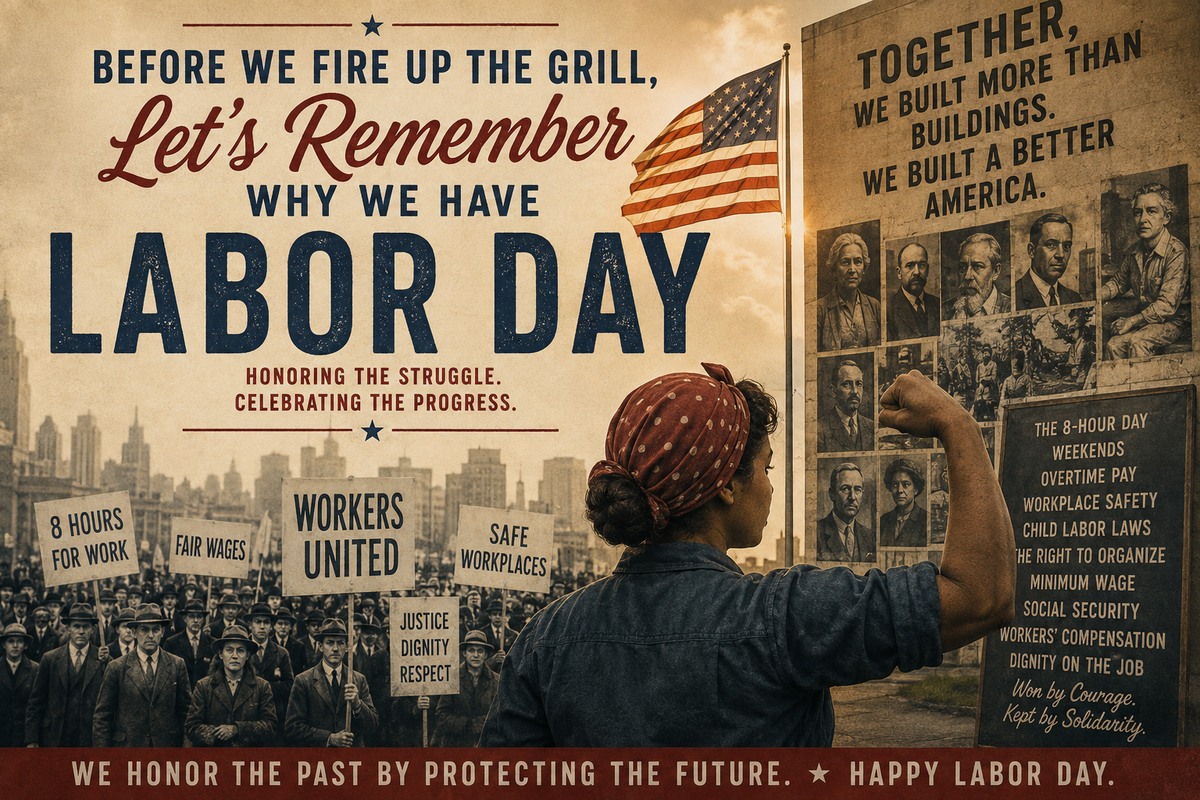
Before We Fire Up the Grill, Let’s Remember Why We Have Labor Day
By Julie Bolejack
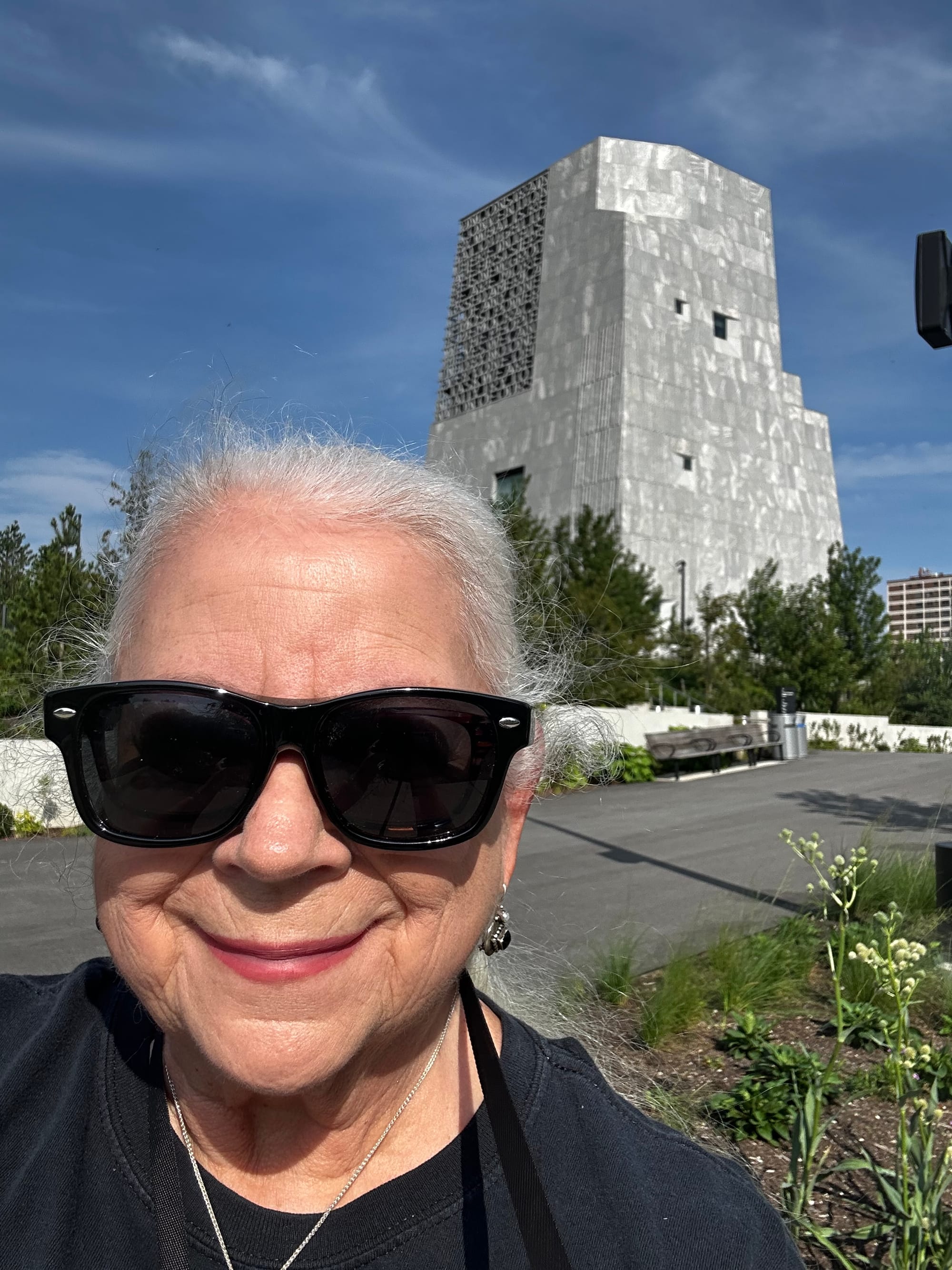
A few days ago, I stood inside the new Obama Presidential Center in Chicago and found myself lingering in front of one of the displays.
Actually, “display” hardly seems adequate.
It was large. Powerful. And, for me, unexpectedly moving.
The exhibit, Toward a More Perfect Union, looks at the movements of ordinary Americans who pushed this country toward becoming something better—including the long fight for workers’ rights.
And standing there, looking at the photographs, names and artifacts from America’s labor movement, I found myself thinking about Labor Day differently.
Because somewhere along the way, Labor Day became the three-day weekend at the end of summer.
The cookout.
The furniture sale.
The last trip to the lake.
The unofficial deadline for putting away the white pants—which, incidentally, I think we can finally agree is a rule nobody needs anymore.
But Labor Day wasn’t created because Americans needed another sale on mattresses.
It was created because working people fought for dignity.
And that fight was long, difficult and sometimes deadly.
We Forget How Hard-Won “Normal” Really Is
Today, we tend to take certain expectations about work for granted.
A weekend.
An eight-hour workday.
Overtime.
Workplace safety regulations.
Restrictions on child labor.
Workers’ compensation.
The ability to organize.
A minimum wage.
Social Security.
The idea that someone injured or killed while doing a job shouldn’t simply be discarded and replaced.
None of these ideas descended from the heavens fully formed.
People fought for them.
In the late 19th and early 20th centuries, American industrialization created extraordinary wealth. But the people producing that wealth frequently worked six or seven days a week, sometimes 10, 12 or even 14 hours a day, under conditions that could be appalling.
Children worked in mills, mines and factories.
Workers were maimed by machinery.
Families could be plunged into poverty when a wage earner was injured.
And if workers protested?
Companies could fire them, blacklist them or bring in armed guards and strikebreakers.
Sometimes state or federal troops became involved.
People died.
The first Labor Day celebration was held in New York City on September 5, 1882. Thousands of workers marched through Manhattan in what was both celebration and demonstration.
By 1894, after years of labor agitation and the violence surrounding the Pullman Strike, Congress made Labor Day a federal holiday.
So when we celebrate Labor Day, we’re celebrating something much bigger than employment.
We’re celebrating the idea that work should have dignity—and that the people doing the work should have power, too.
That was what struck me so strongly at the Obama Presidential Center.
History changes when ordinary people decide something is no longer acceptable.
The Center describes this part of its museum as an exploration of the “push and pull of democratic progress,” including the fight for workers’ rights.
I love that description.
Because progress rarely moves in a straight line.
People push.
Power pushes back.
People organize.
Institutions resist.
Someone says, This is simply the way things are.
And eventually someone else says:
Well, maybe it shouldn’t be.
That sentence has changed America more times than we probably realize.
Ten People Worth Remembering This Labor Day
There are hundreds of names that belong on this list. These ten don’t represent the entire American labor movement—no ten people possibly could.
But if we’re going to celebrate Labor Day, we ought to know at least a few of the people whose courage helped create the working world we inherited.
1. Mother Jones
Mary Harris Jones became one of America’s most famous labor organizers around the turn of the 20th century.
Workers called her Mother Jones.
She organized miners and their families, opposed child labor and became such an effective agitator that one prosecutor reportedly described her as “the most dangerous woman in America.”
She was in her 60s and 70s during some of her most important organizing work.
Naturally, I love that part.
Never tell a determined older woman that her useful years are behind her.
2. A. Philip Randolph
Randolph organized the Brotherhood of Sleeping Car Porters, representing predominantly Black railroad workers who faced low wages, exhausting schedules and discrimination.
After years of struggle, the union won recognition from the Pullman Company.
Randolph also understood something profound: labor rights and civil rights could not be separated.
Decades later, he helped organize the 1963 March on Washington where Martin Luther King Jr. delivered his “I Have a Dream” speech.
3. Frances Perkins
Frances Perkins wasn’t a union organizer. She was something equally important: a government official who turned reform into law.
After witnessing the horrifying Triangle Shirtwaist Factory fire in 1911, where 146 garment workers died, Perkins devoted much of her career to improving working conditions.
President Franklin Roosevelt appointed her Secretary of Labor in 1933, making her the first woman to serve in a presidential Cabinet.
She became instrumental in shaping Social Security, unemployment insurance, minimum-wage protections and limits on child labor.
Millions of Americans live with her legacy without ever knowing her name.
We should know it.
4. Samuel Gompers
An immigrant cigar maker, Samuel Gompers helped found the American Federation of Labor in 1886 and became one of the most influential labor figures in American history.
He believed workers could improve their lives by organizing around practical goals: better wages, shorter hours and safer working conditions.
It sounds remarkably modest today.
At the time, it was revolutionary.
5. Eugene V. Debs
Debs began as a railroad worker and became one of America’s most famous labor organizers.
He helped organize the American Railway Union and became a central figure in the Pullman Strike of 1894.
Debs was jailed for defying a federal injunction during that struggle.
Whatever one thinks about his later socialist politics, his willingness to challenge enormous concentrations of corporate power made him one of the defining figures of the American labor movement.
6. Walter Reuther
Walter Reuther helped transform the United Auto Workers into one of America’s most powerful unions.
He helped lead the famous Flint sit-down strike era and later pushed automobile companies for better wages, pensions, health benefits and working conditions.
But Reuther’s vision extended beyond the factory.
He supported civil rights and marched with Martin Luther King Jr.
Once again, the movements intersected.
Workers’ rights.
Civil rights.
Human rights.
They were never as separate as our history books sometimes make them appear.
7. César Chávez
Chávez co-founded what became the United Farm Workers and helped bring national attention to the brutal conditions faced by agricultural laborers.
Through strikes, marches, fasting and consumer boycotts—including the famous grape boycott—Chávez helped Americans understand that the inexpensive food on their tables often came at an enormous human cost.
His movement gave us one of the most enduring phrases in American activism:
Sí, se puede.
Yes, it can be done.
Sound familiar?
It should.
8. Dolores Huerta
And Chávez didn’t do it alone.
Dolores Huerta co-founded the organization that became the United Farm Workers and was a formidable organizer and negotiator in her own right.
In fact, Huerta originated the phrase “Sí, se puede.”
Her story is also an important reminder of something that happens far too frequently in history:
We remember the man and forget the woman standing beside him doing much of the work.
Not this Labor Day.
Remember Dolores Huerta.
9. Larry Itliong
Another name Americans should know.
In 1965, Filipino American labor leader Larry Itliong and members of the Agricultural Workers Organizing Committee launched the Delano grape strike in California.
More than 800 Filipino farmworkers demanded better wages and working conditions.
Chávez’s predominantly Mexican American organization joined them shortly afterward.
That coalition helped create one of the most important agricultural labor movements in American history.
The Obama Presidential Center specifically remembers this history in its labor collection.
10. Addie Wyatt
And finally, a Chicago woman—which seems particularly appropriate after my visit.
Addie Wyatt worked in a Chicago meatpacking plant and became a pioneering labor organizer, civil rights activist and advocate for women.
She fought discrimination inside workplaces and inside the labor movement itself.
In 1974, she became a founding member of the Coalition of Labor Union Women.
Her life embodied something we still struggle to understand:
Economic justice, racial justice and women’s equality are not separate conversations.
They are threads of the same fabric.
And Then There Were Millions More
Here’s the part I don’t want us to forget.
History books naturally give us leaders.
But movements aren’t made only by leaders.
They are made by people whose names disappeared.
The garment worker standing on a picket line.
The miner refusing to enter an unsafe shaft.
The Black railroad porter quietly organizing coworkers.
The immigrant woman sewing clothes in a factory.
The farmworker walking off a field.
The autoworker occupying a plant.
The mother wondering how she would feed her children while her husband was on strike.
The worker who voted for a union knowing it might cost him his job.
The woman who demanded equal pay long before anyone considered that demand reasonable.
Millions of people took risks so that people they would never meet could have better lives.
Those people include us.
That is what I found myself thinking about in Chicago.
We inherit things and eventually begin believing they simply appeared.
Democracy.
Civil rights.
Women’s rights.
Labor protections.
They didn’t.
Someone fought for them.
And that may be the most important lesson of Labor Day in 2026.
Progress Is Not Self-Sustaining
Rights won can be weakened.
Protections created can be dismantled.
Institutions built over generations can be changed surprisingly quickly.
History does not guarantee that yesterday’s progress will still be here tomorrow.
Every generation inherits both the accomplishments and the unfinished work of the generation before it.
That’s why that enormous labor display at the Obama Presidential Center felt so timely to me.
It wasn’t really about the past.
It was asking something of us in the present.
What do we believe working people deserve?
A living wage?
Safe working conditions?
Healthcare?
Time with their families?
A dignified retirement?
The ability to organize without fear?
The opportunity to work hard and actually build a decent life?
Those questions aren’t relics from 1894.
They’re questions for 2026.
So this weekend, enjoy Labor Day.
Please.
Have the cookout.
See your family.
Take the boat out one last time.
Sit on the porch.
Eat something you probably shouldn’t.
And if you find a really good mattress sale, I’m certainly not going to stand in your way.
But sometime during the weekend, take just a moment to remember what the holiday actually represents.
People stood together.
People spoke up.
People demanded better.
And because they did, millions of Americans who came after them lived better lives.
Including us.
That seems worth celebrating.
And it certainly seems worth remembering.
Happy Labor Day.
And as always, thank you for reading Julie’s Journal. Thank you to those of you who share these essays with friends and family, and thank you to everyone who subscribes and keeps this little community growing.
If someone came to mind while you were reading this, please send it to them. That’s one of the simplest—and most meaningful—ways you can support my work.
Until next time,
Julie Bolejack, MBA
The Mindful Activist
to subscribe: julies-journal.ghost.io